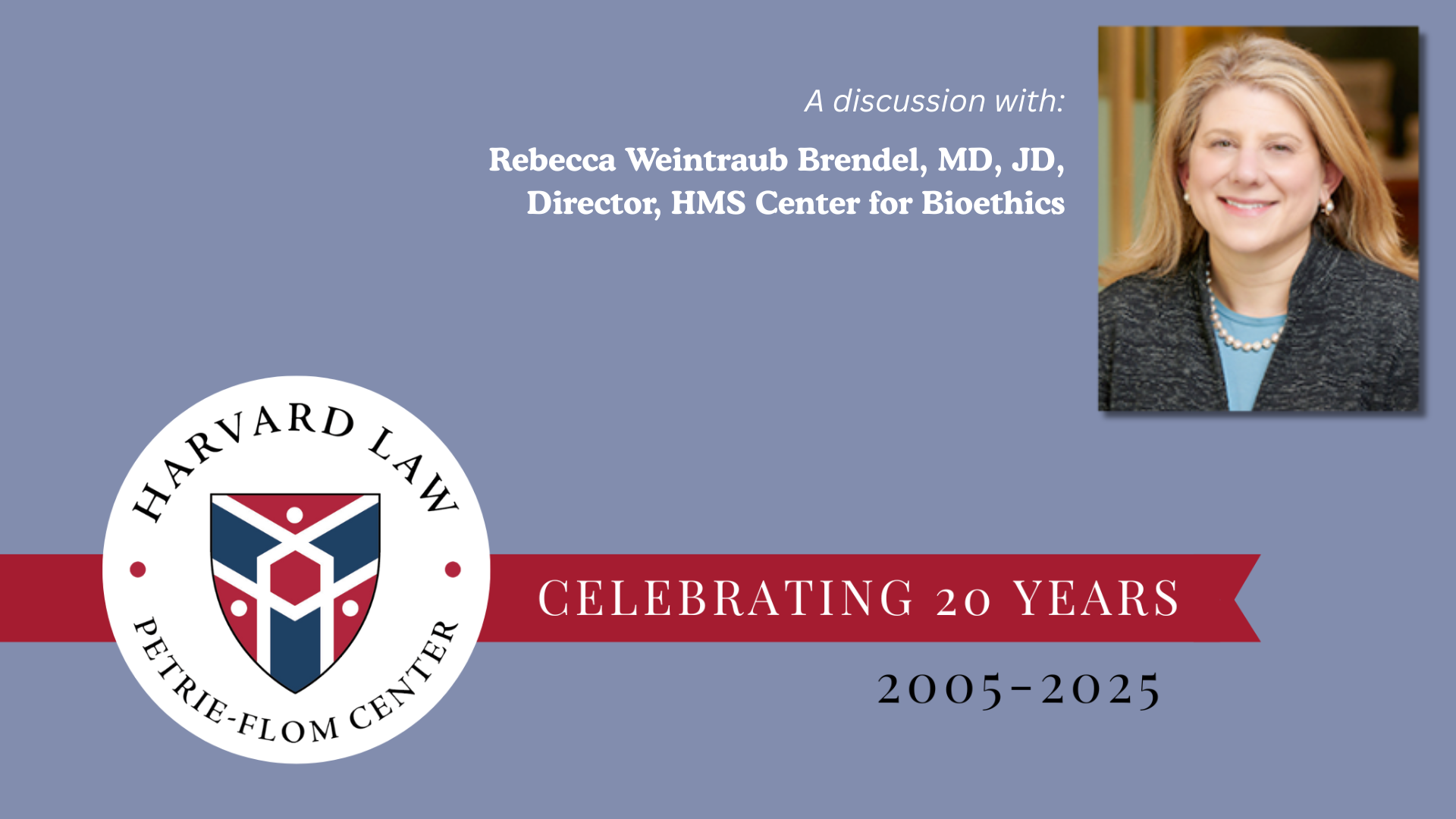
Reflections on the Petrie-Flom Center’s 20th: Rebecca Weintraub Brendel
To mark our 20th anniversary, the Petrie-Flom Center reached out to some of our esteemed colleagues for their reflections. Please enjoy this first installment, from Rebecca Weintraub Brendel.
Published
Author
Share
To mark our 20th anniversary, the Petrie-Flom Center reached out to some of our esteemed colleagues for their reflections. Please enjoy this first installment, from Rebecca Weintraub Brendel.
Petrie-Flom Center: Tell us about your history of working with the Petrie-Flom Center and faculty director Glenn Cohen.
Becca Brendel: I was introduced to Glenn by Alan Stone (who was a mentor to both of us) around the time that Glenn was finishing law school. Alan was sure that Glenn was going to be a rising star in the world of law and certainly was very interested in Glenn’s interest in ethics. Alan was not one to frequently lavish praise on people, so it caught my attention.
Later, Glenn and I had the opportunity to teach together. It was great fun, and the beginning of a long and intertwined path between law and medicine and ethics together that involved a lot of thinking and hard work and also a lot of laughing and play with the material. To find a colleague you can so naturally engage with and learn alongside is a really special gift.
How has the Petrie-Flom Center made an impact?
When I moved over to the HMS Center for Bioethics in 2014, Glenn and Holly [Fernandez Lynch] immediately welcomed me in, and it really became a partnership between the Petrie-Flom Center and the Center for Bioethics that has endured to this day. At that point, Petrie-Flom was an established player, already in its 10th year, and we were just the new kids on the block, trying to figure out how to go from being a division of another department to being an independent center.
Glenn’s generosity of spirit and intellect was pivotal in helping us get our footing. His support, which has continued from Holly to Carmel [Shachar] to Susannah [Baruch], has made it possible for both of our centers to do our best work. Glenn and I, through our centers, have co-sponsored so many programs over the years which have really embraced the possibility of true interdisciplinary work in advancing bioethics, something that is surprisingly often hard to do between schools at Harvard.
Right now, what issues and topics in health law are top of mind for you in your own work?
I’ve always been incredibly grateful to be welcomed at Petrie-Flom on some of the areas of overlap, most recently around psychedelics, and some of the work now with Susannah’s interest in moral leadership and reproductive law and ethics. It’s been collaborative from the very beginning, and all those relationships still go on. That’s really fostered by Glenn’s laser focus, intellect, generosity, and commitment to being a bridge-builder.
If you look now at the people doing really interesting and groundbreaking work in the law and bioethics realm, the sheer number who have done some part of their training, work, or career development at Petrie-Flom is nothing short of staggering. This is a testament to Glenn’s vision and leadership.
Help us see around corners: What do you think PFC should focus on in the near and/or long-term future?
I think the strength of Petrie-Flom, and in particular under Glenn’s leadership now, is to be framing the big questions in a way that they need to be asked, as opposed to just dabbling in interesting conversations. Petrie-Flom has fostered work that’s actionable in terms of paradigms and frameworks that we can use moving forward within any related field, whether it be bioscience, biopharma, or technology and the development of legal, ethical, and regulatory approaches or policies.
PFC should focus on remaining at this leading edge at a time in which everyone seems to be interested in questions about bioethics and biotechnology but not all are committed to ensuring the integrity of science and health care . Remaining true to the things that have made the work at Petrie-Flom so influential in the first place is both more critical and potentially more challenging than ever. Inoculating against the undermining of data and science by assessing and centering both, and appreciating how the empirical, the normative, and the practical all must be present and come together to make actionable and impactful change should continue to guide PFC into its third decade.
Glenn’s accessible and warm demeanor and commitment never to make anybody feel lesser lifts everyone and elevates the work and its impact.
Rebecca Weintraub Brendel
Anything else you’d like to say about Glenn and/or PFC?
There are few people like Glenn who are so enormously brilliant and intellectually capable. While he’s brilliant (perhaps freakishly so), he’s never frightening, intimidating or condescending. He’s the consummate colleague, and you can tell his enormous intellectual capacity by his ability to say things in the most straightforward and accessible way. By doing so, he draws people in.
Even rarer, Glenn’s accessible and warm demeanor and commitment never to make anybody feel lesser lifts everyone and elevates the work and its impact. In doing so, Glenn has created a special place that emphasizes and epitomizes the best an academic center can do: facilitate and promote the free and respectful exchange of considered ideas to achieve progress and advance humanity.