LSD Gospel, Christmas Tidings, and the FDA during the Psychedelic Sixties
Academics and enthusiasts alike often consider the 1960s a “psychedelics golden age” of access, research, and culture.

Published
Author
Share
Academics and enthusiasts alike often consider the 1960s a “psychedelics golden age” of access, research, and culture. A significant reason is their assumption that psychedelics were easy to get because few laws criminalized their possession or sale prior to the Comprehensive Drug Abuse Prevention and Control Act of 1970. But that story leaves out the legal predecessors to the Controlled Substances Act, specifically the Food, Drug, and Cosmetic Act (FDCA) of 1938.
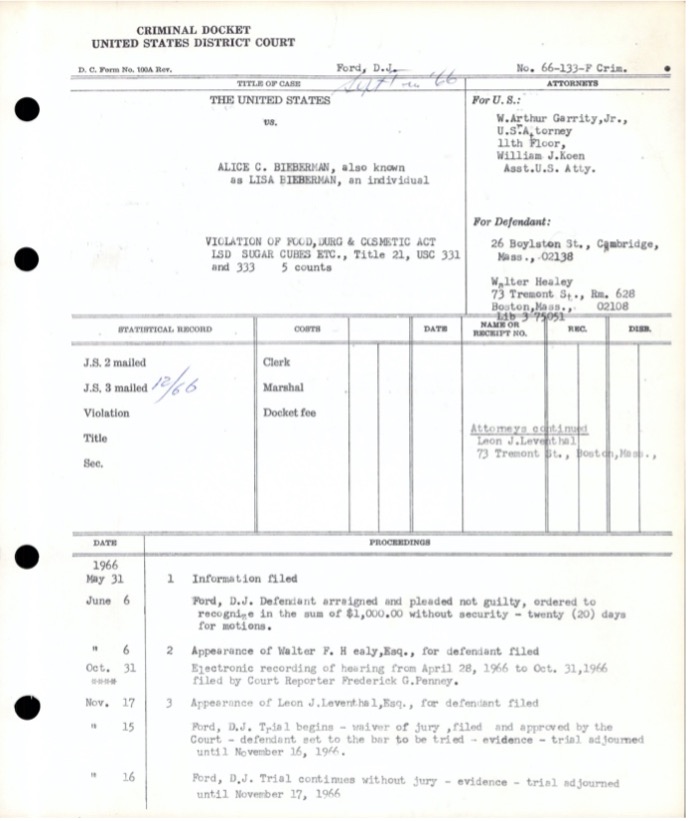
This essay corrects the false notion of a legal psychedelic “free-for-all” through the story of Lisa Bieberman, an LSD enthusiast and Harvard Square denizen of the 1960s. I draw upon archival research at the Peter Stafford Papers at Columbia University for Bieberman’s bimonthly publication, the Psychedelic Information Center Bulletin, and the Cambridge Public Library Archives for Bieberman’s never-published memoir manuscript, To Mark A Spot: A Psychedelic Pilgrimage. Bieberman was prosecuted under the FDCA, which gave the FDA authority to regulate food, drugs, medical devices, and cosmetics. According to a story in the Harvard Crimson, she was the first person in New England prosecuted for an LSD violation under the FDCA, for illegally shipping LSD through the mail.
Bieberman was a Radcliffe graduate (’63) who encountered psychedelics through Timothy Leary and Richard Alpert, two faculty in Harvard’s Department of Social Relations, just as their time at Harvard screeched to a halt. Upon her graduation, she worked for Leary and Alpert’s para-academic organization, the International Federation for Internal Freedom, which Bieberman describes in her memoir as continuing Leary and Alpert’s research, starting a pharmaceutical lab, and launching a combination clinic-utopian colony (71-72). She kept their Cambridge headquarters afloat while Leary, Alpert, and company flew off to Mexico, the Caribbean, and eventually upstate New York.
Bieberman started the Psychedelic Information Center (PIC) in Harvard Square in 1965, releasing a bimonthly bulletin where she reported on changing drug laws, sold mushroom grow guides, publicized new psychedelic churches, and attempted to correct myths, like whether smoked banana peels are a psychedelic (they aren’t).
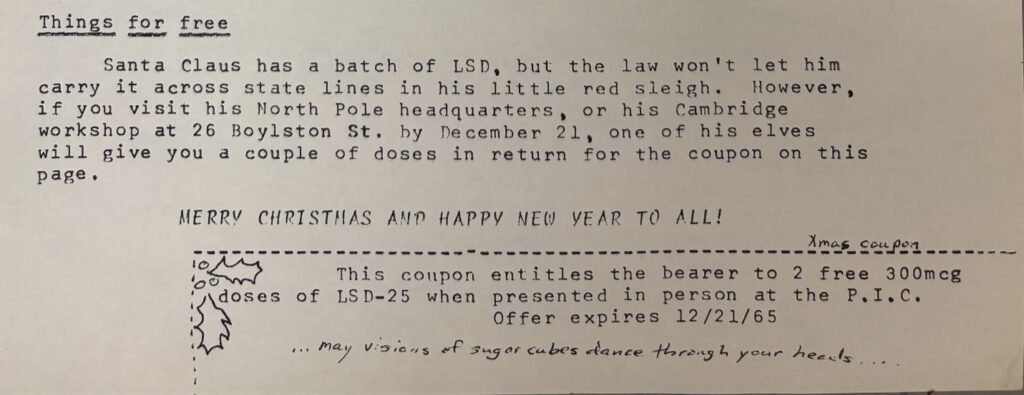
In 1965, in the third installment of her PIC Bulletin, Bieberman provided an open offer for LSD for Christmas: “Santa Claus has a batch of LSD, but the law won’t let him carry it across state lines in his little red sleigh.” Based on the offer, it is clear she was aware of her limitations per the FDCA. Nevertheless, based on information in her memoir, she mailed LSD to a handful of out-of-state requests (242). Bieberman reports that on March 18, 1966, she received a letter from the FDA that threatened prosecution for shipments of LSD across state lines to Kansas, Missouri, and California with improper labeling (under FDCA, (502)(e)(1)(A)(i), per the FDA Papers, 35). She had sent sugar cubes to a student in Kansas who had apparently publicized his acquisition a bit too loudly; and Bieberman alleged that the FDA caught wind of him (242-243). She was arraigned in the summer of 1966 and pleaded not guilty. The day after her arraignment, Bieberman left Boston for UC Berkeley’s LSD Conference.
In mid-November of 1966, Bieberman at last had her day in court — three days, in fact. According to her memoir, she found her lawyer inept —Bieberman felt she had done far more research on her case than her lawyer could ever be convinced of doing (295-297). The judge found her guilty of violating the Food, Drug, and Cosmetic Act: four counts of mailing LSD without proper labeling. She was sentenced to a year of probation.

While the state’s sentence was light, the extralegal consequences were worse. After her sentencing, Bieberman reported that she was urged by her department at Brandeis University, where she had just begun a PhD in Psychology, to resign (299). Because of her drug conviction, the Massachusetts Registry of Motor Vehicles refused to renew her driver’s license.
Bieberman’s run-in with the law did not dissuade her from psychedelic advocacy. Two months after her sentencing, she published Session Games People Play: A Manual for the Use of LSD. In her Bulletin in April 1967, she devoted several paragraphs to the confused state of the law regarding psychedelic research and how researchers can obtain and manufacture their own LSD. She implores her readers to pick up the Drug Abuse and Control Amendments (1965) for themselves, as “too few people read the law books, and (contrary to popular belief) they are really not hard to read.”
Bieberman’s case demonstrates that the FDA would prosecute cases involving psychedelics in the ’60s, counter to the common conception that all activities involving psychedelics were legally unrestricted until the Controlled Substances Act. In fact, this was a known risk, as Bieberman notes in her Christmas coupon, and in her frequent admonitions against secrecy and paranoia among psychedelic enthusiasts.
In an essay for The Boston Globe Magazine in 1968, Bieberman insisted that paranoia and underground activities cannot be the winning strategy – nor were religious arguments likely to be compelling if they were disingenuous: “Most psychedelic groups up till now have kept their activities nine-tenths submerged; when they get in trouble they scream religious persecution. But I do not think our courts will ultimately choose to persecute religion, where it proves itself genuine and conscientious.” While Bieberman did not take up a legal defense on the grounds of religion for her use and advocacy of LSD, she did become a devout Quaker. In an essay titled “Phanerothyme: A Western Approach to the Religious Use of Psychochemicals,” Bieberman offered a model of using psychedelics in a Quaker style. Rather than offering legal protection, Bieberman’s religious approach to LSD was intended to support the lessons that a psychedelic experience “has to teach, to support one’s companions in their search, and to put the insights gained into practice in living.”