Event Recap: Conscience in Health Care: Dov Fox in Conversation With I. Glenn Cohen
The Petrie Flom Center recently welcomed Dov Fox, Professor of Law and the Director of the Center for Health Law Policy and Bioethics at the University of San Diego School of Law, to discuss his new book.
Published
Author
Share
The Petrie Flom Center recently welcomed Dov Fox, Professor of Law and the Director of the Center for Health Law Policy and Bioethics at the University of San Diego School of Law, to discuss his new book.
In his book “The Conscience of Care,” Professor Fox explores the legal asymmetry between the permissive standard for medical conscientious refusers and the lack of a legal allowance for performance of banned procedures that align with a medical professional’s conscience. The news frequently contains stories dealing with medical conscience controversies around health care services like IVF, IUDs, opioids, gender affirming care, organ transplants, and advance directives.
“We’re used to hearing about conscientious refusers: physicians and pharmacists whose moral convictions lead them to deny a range of treatments that they deem sinful or wrong,” Fox writes. “Less familiar in public discourse are those medical professionals who have weighty reasons of their own for supplying treatment in ways that state law or institutional policy forbids. Call them conscientious providers.”
“This book intriguingly flips our understanding of conscience by engaging a wide range of care to consider — from pain relief to medical aid in dying. And Professor Fox urges us to reckon meaningfully with our deepest values and consider how conscience and that concept might play a more equitable role,” began Susannah Baruch, the Executive Director of the Petrie-Flom Center, as she opened the Center’s recent event, “Conscience in Health Care.”
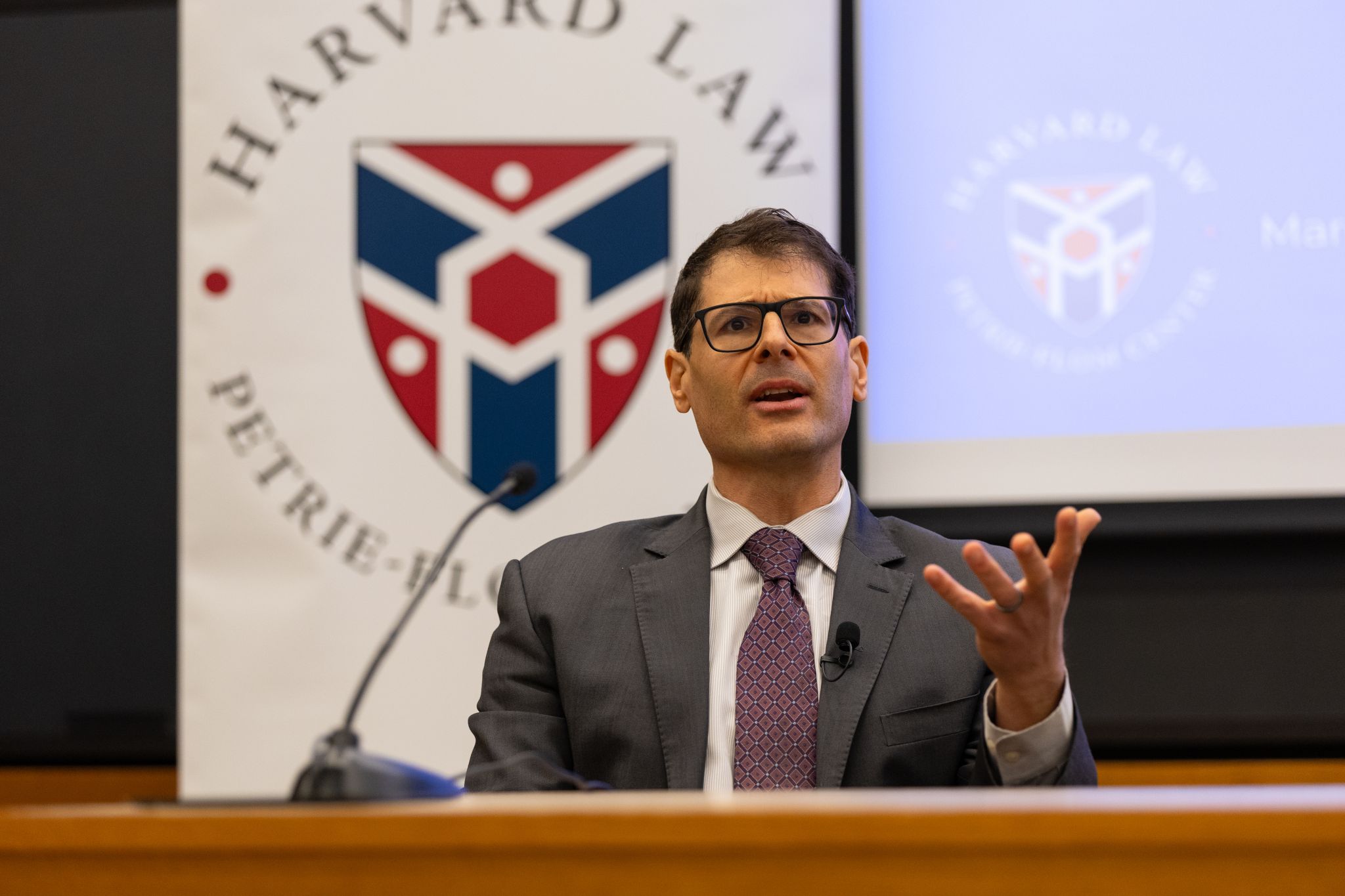
Professor Fox was joined by I. Glenn Cohen, Deputy Dean and Professor at Harvard Law School and Faculty Director of the Petrie-Flom Center, to delve further into the book’s hypothesis.
Professor Cohen stepped into the devil’s advocate role, pushing Professor Fox on how he would respond to two potential objections to his book. Primarily, Professor Cohen raised a potential rebuttal that the book actually is more politically normative than presented, asking how Professor Fox would reply to someone who says his book “really has a very strong political valence that the examples always lean the direction that good liberals like.” Professor Cohen added a second potential critique of the book’s presentation as a universal project, which “presents generalized universal principles that are good for abortion, good for opioids, good for conversion therapy, but quite hard to divorce one’s views about the ethics or moral valence of the particular issues.”
Professor Fox took these potential critiques of his book head-on. Acknowledging that “it is easy to have that reaction in the current political moment with how things might seem to align,” he stated that taking a broader historical view shows that his book is not just a liberal project and does have universal applicability not just based in his norms.
He offered the example of the early 20th century medical establishment on “the left” who would have “mandated birth control for minority populations” and “stood behind rules like Virginia’s mandatory sterilization law” as example of how norms of the medical establishment and the care they conscientiously provide evolve dramatically, even within one side of the political divide. With changing norms and additional evidence questioning a procedure’s properness and efficacy, justified conscientious providers may now align more with liberal norms, but such a dynamic could quickly change with time. Changing categorizations like homosexuality’s previous medical categorization as a disease only a few decades ago evinces how medical norms can change. Professor Fox states that his framework would still be valid with those changing norms and evidence.
“When patients are dying and clinicians are experiencing deep moral distress that their colleagues on the refusing side don’t have to endure for a reason that I don’t think is justified, then we would do well to balance out these protections in ways that would promote pluralism better and would not defeat states’ interests but serve them.”
Professor Dov Fox
During the question-and-answer portion of the event, an attendee challenged Professor Fox’s reliance on medical board evaluation of an intervention’s evidence when a provider conscientiously objects to a legislative ban on the procedure. The attendee noted that Professor Fox’s standard may lead to judges relying on “unaccountable medical boards that … have made terrible decisions” in some of Professor Fox’s examples. Given that history, the attendee questioned reliance on medical boards over state governments who in the aggregate may make some poor medical determinations, but are still democratically accountable. The question asked whether his framework is “shoving the accountability onto some different group that doesn’t have any democratic control.”
Professor Fox replied that allowing the judiciary to evaluate evidence from the medical community falls squarely within its typical functions of determining sentencing and permitting defenses. Additionally, “the judiciary has historically performed a very important function … when there are profound harms that go unrecognized in our laws, as slow as they work, as difficult as it is to achieve structural change through those democratic processes, where judges can step in.” He thus supports the judiciary stepping in to change the current conscience regime “that’s deeply unprincipled.” “When patients are dying and clinicians are experiencing deep moral distress that their colleagues on the refusing side don’t have to endure for a reason that I don’t think is justified, then we would do well to balance out these protections in ways that would promote pluralism better and would not defeat states’ interests but serve them.”
The event engaged with some of the most contested aspects of Professor Fox’s thesis in “The Conscience of Care.” Challenging how medical professional and lawyers typically conceive of conscience in health care, Professor Fox presented a compelling, novel framework that identifies an important asymmetry in how medical providers’ morals interact with the care they provide.