Your Records Trained the Algorithm. What Did You Get Back?
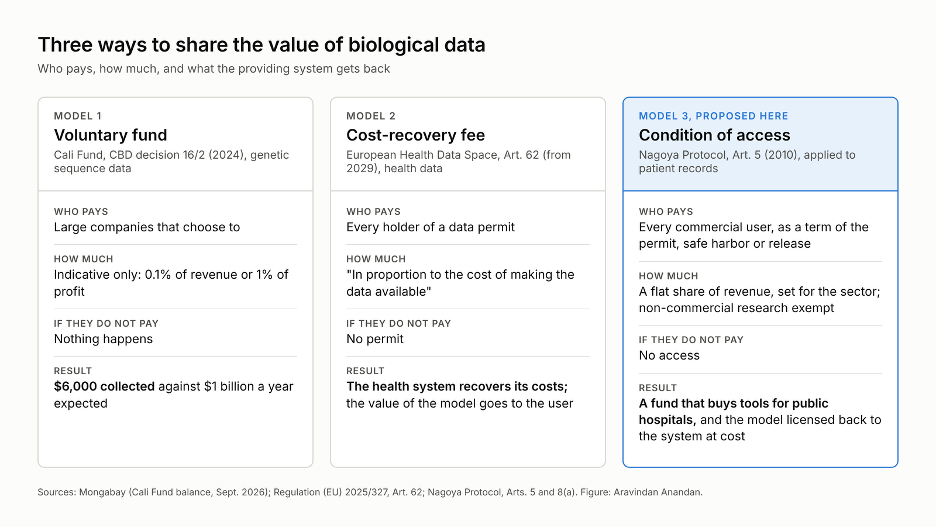
Delegates at October’s UN biodiversity summit in Yerevan arrived with an awkward number in their briefing papers. The Cali Fund, created two years ago to collect a share of profits from users of genetic sequence data, had received only $6,000 against an expected $1 billion a year.

Published
Author
Share
Delegates at October’s UN biodiversity summit in Yerevan arrived with an awkward number in their briefing papers. The Cali Fund, created two years ago to collect a share of profits from users of genetic sequence data, had received only $6,000 against an expected $1 billion a year. It is tempting to read that as proof that benefit-sharing for data cannot work.
The better reading is that benefit-sharing which asks politely cannot work, and that health law is about to repeat the mistake with a far larger dataset than anything on the Yerevan agenda.
Two separate regimes already accept that those who profit from biological information owe something to the people it came from. The Nagoya Protocol says so for genetic resources, and the 2024 Cali decision extended it to digital sequences, naming artificial intelligence among the sectors expected to pay. The WHO Pandemic Agreement of May 2025 puts benefit-sharing on an equal footing with access to pathogen data.
Patient records are the third category, the largest by far, and the one with no rule at all. Clinical AI is trained on diagnoses, scans, heart rhythms and discharge notes from millions of encounters that nobody thought of as a data-generation shift.
Mayo Clinic supplied 2.8 million patient electrocardiograms to a start-up, took an equity stake, and did not tell the patients. A Chicago patient who sued after his hospital shared records with Google to build predictive models was told by the Seventh Circuit in 2023 that the records belonged to the hospital, that he had acknowledged research use without compensation, and that a claim “cannot be based solely on a defendant’s gain.”
It turns out that once the identifiers are stripped, the data is no longer protected under the federal privacy rule and no longer, in any sense a court will enforce, the patient’s. De-identification takes the name out of the record and leaves the value in the model.
Europe has built the world’s most elaborate system for secondary use of health data and priced it at cost. The European Health Data Space regulation, which applies to secondary use from 2029, allows model training under a permit and lets access bodies charge fees “in proportion to the cost of making the data available.” The health system recovers only what it cost to hand the data over; the value goes to the user.
India, with one of the largest untapped training sets on earth, has gone the other way. Its new data protection law exempts research from the ordinary rules so long as whoever uses the data takes no decision about any particular individual. India’s digital health policy releases anonymized records on whatever terms the National Health Authority stipulates, without a word about return. The State meanwhile plans to put its own AI decision-support tool into nearly 70,000 hospitals, giving clinical AI away before learning to charge for the data that makes it.
Economists have argued since 2018 that data is better understood as labor than as raw material, and Elinor Ostrom showed that shared resources are best governed by rules the people who use them help write. A hospital’s records are the collective product of a community’s illnesses and a workforce’s effort, paid for by taxes or premiums, and treating them as a windfall for whoever strips the names is an enclosure: common land fenced off for private gain.
Medical ethics reached this conclusion a generation ago. The HUGO Ethics Committee proposed in 2000 that companies profiting from genetic research devote 1 to 3 percent of net profits to health infrastructure, and the 2005 UNESCO bioethics declaration says research benefits “should be shared with society as a whole.” Both appealed to conscience rather than to the instruments that grant access, and the Cali Fund’s balance shows how little such appeals collect.
The Nagoya model works where benefit-sharing is a condition of access rather than a request made afterwards, and health law holds the same levers. No data permit, no de-identification safe harbor for commercial model training, and no release under a national policy should issue without a benefit-sharing term attached.
The term should do two things, as Nagoya’s benefits do. First, it should require a payment, set as a share of the revenue earned from the data and paid into a fund that buys the resulting tools for public hospitals and the infrastructure they run on. Second, it should attach a condition to the license: any model trained on a public system’s records must be available to that system at cost.
Britain already runs a revenue-based payback on branded medicines, set at 14.5 percent of eligible sales for 2026, and NHS England’s framework for data partnerships says the NHS “should share in the value created by its data.” What is missing is a rule for every licensee rather than for whoever negotiates well. Consultants valued NHS records at £9.6 billion a year in 2019.
Three objections are predictable, and each has an answer. Attribution is hard, but the permit or data use agreement names the dataset, and a flat sector rate above a size threshold, as Cali proposed, needs no valuation. Research would be chilled, so the term should attach to commercial training only, as Nagoya’s simplified access for non-commercial research does. Patients will not be paid individually, nor should they be: the courts have closed that route and HUGO placed the benefit with the community that produced the records.
No new statute is needed. In Washington, the U.S. Department of Health and Human Services (HHS) already requires a data use agreement before a limited data set leaves a hospital and could require the same, with a benefit-sharing term, before de-identified records are licensed for commercial training; Congress could add the payment. In Brussels, the first evaluation of the European Health Data Space Regulation could propose a value-based component to Article 62, and in Delhi the National Health Authority’s terms of release could carry the condition tomorrow.
The countries with the most patients and the fewest tools have no such rule in place. That is where biodiversity-rich countries stood before Nagoya. The delegates in Yerevan discovered that a fund without a lever is a fund without money, and went home without one: contributions stay voluntary, and the fund’s first assessment is not due until 2028. Health ministries can learn that lesson without the trip.