Petrie-Flom Center
Event Recap: What Is Health Law?
On September 30, five prominent Harvard Law School alumni told a packed room about how the field of health law has developed, through the lens of the varied paths that led them to their careers.
Published
Author
Share
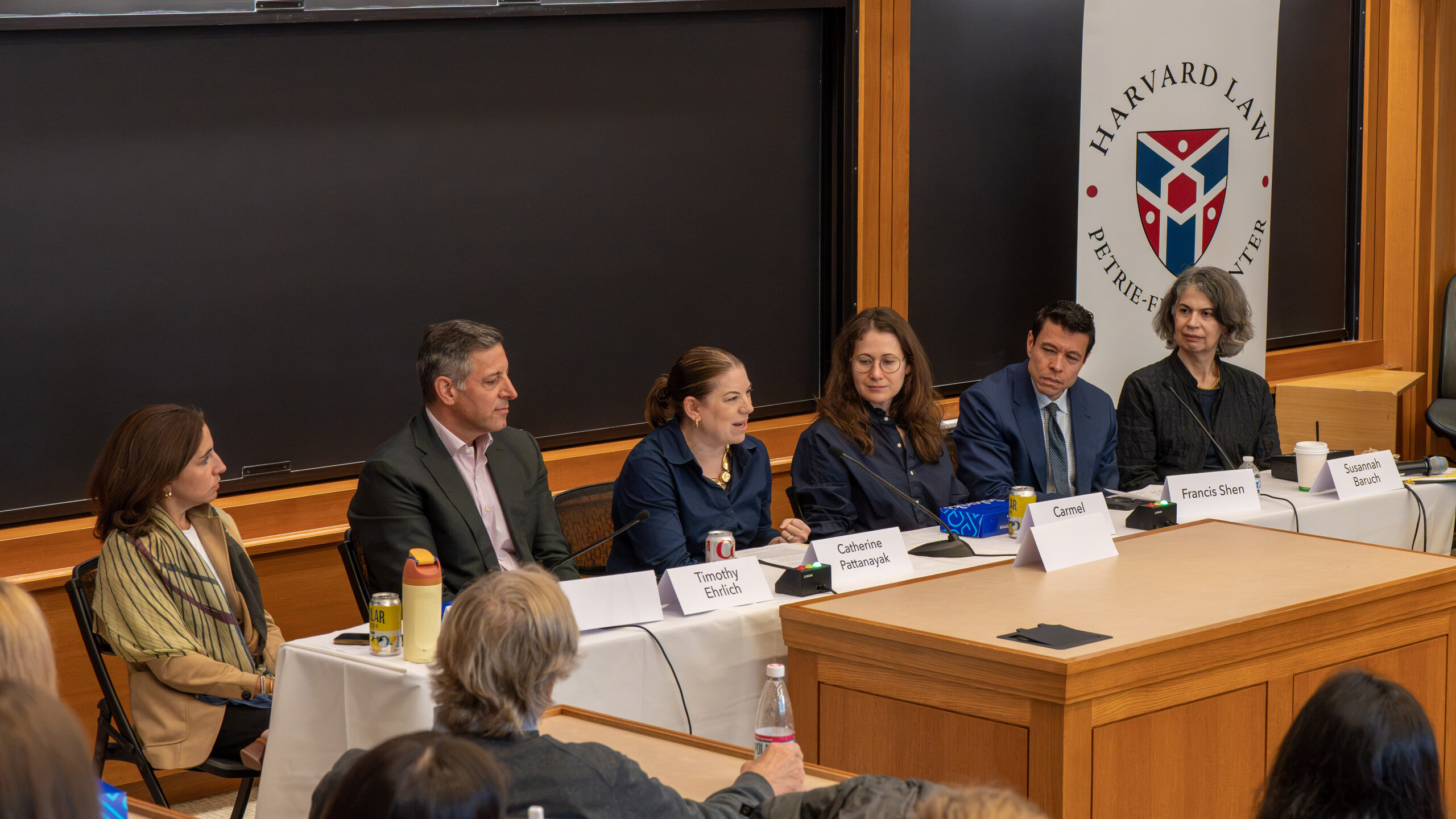
On Sept. 30, five prominent Harvard Law School alumni told a packed room about how the field of health law has developed, through the lens of the varied paths that led them to their careers. Susannah Baruch, Executive Director of the Petrie-Flom Center at Harvard Law School, introduced the panel, noting that “health law” as such didn’t really exist just a few decades ago, welcoming the panelists whose stories show how unexpected opportunities and interdisciplinary questions have shaped the field.
- Emily Broad Leib, started her career in international human rights and humanitarian law, later working with community groups, farmers and local organizations dealing with issues in food systems, public health, and economic growth. This experience led her to found and lead the Food Law and Policy Clinic at HLS.
- Timothy Ehrlich, who leads the Life Sciences Practice Group at Gunderson Dettmer, studied classics in college and later worked in internet governance, antitrust, and transactional law for biotechnology companies. Now, he helps entrepreneurs and investors handle the legal and business challenges of developing new medical products and emphasized that health lawyers can play a key role in supporting scientific.
- Catherine Pattanayak, currently the Assistant Dean for Public Service at HLS, built her previous career around science, public health, and government. At the Massachusetts Department of Public Health, in private practice, and in the Office of General Counsel at the National Institutes of Health, she had opportunities to shape policy and practice alike.
- Carmel Shachar, who leads the HLS Health Law and Policy Clinic, became interested in health law through the lens of healthcare access and patient experiences. After earning both a JD and an MPH, she advised healthcare clients in private practice, then moved into clinical and policy advocacy.
- Francis Shen, who leads the Shen NeuroLaw Lab, shared his thoughts about how neuroscience can help the law better understand behavior, decision-making, and responsibility, especially in criminal justice. Shen noted that in his field lawyers have opportunities to work with new scientific discoveries and rethink old legal ideas.
For more on these career stories, the connections among law, clinical care, and society, and how AI, science and biotechnology are changing the field, we invite you to watch the video here. Details of the event are here.