
Global Health and Rights Project (GHRP)
Overview
Launched in 2019, the Petrie-Flom Center addresses some of the most pressing issues at the intersection of law, international development and global health. With a focus on Latin America, GHRP seeks to advance theorization of a “right to health” under international and applicable domestic law as well as an understanding of the challenges to using human rights to advance health justice that are rooted in national and global political economies. Since the COVID-19 pandemic, GHRP has also increasingly focused on global governance for health, which has recently been upended by the Trump administration.
GHRP includes a Senior Fellowship and affiliated researchers, as well as Visiting Researchers who develop their own research in conjunction with GHRP’s Project Lead. GHRP convenes public symposia and events as well as conducting policy-relevant research projects, which are virtually always inter-disciplinary and are carried out in collaboration with partners at Harvard and around the globe.
As part of its commitment to advancing equity in global health, the Global Health and Rights Project approaches health as a matter shaped by structural inequalities, including gendered divisions of labor and economic marginalization. From a feminist human rights perspective, barriers to healthcare are often rooted in broader systems of social reproduction, financial precarity, and unequal responsibility for sustaining households and communities. These dynamics directly affect autonomy, access to services, and the effective enjoyment of fundamental rights. By incorporating feminist legal analysis into its work, the Project highlights how global health governance, economic policy, and human rights law intersect, and why gender justice is essential to achieving meaningful health equity worldwide.
Background
Why the focus on Latin America? Although an extremely diverse region, Latin American countries share high degrees of social inequality along axes of class, race, ethnicity and gender, which is refracted in disparities in health status and access to care. Latin American countries share some common institutional challenges, including highly fragmented health systems and regulatory gaps and failures. At the same time, the region is unique in how many countries have recognized the right to health autonomously in their constitution or by incorporation through international treaties, or both, and in turn permit judicial enforcement of health-related rights. In recent years feminists and other groups have made enormous advances in respect of sexual and reproductive health and rights, including access to abortion. Likewise, the region has some of the most innovative jurisprudence and standards on climate and health.
The Project engages in policy and research projects that identify and critically analyze the use of distinct approaches for advancing and protecting population health, as well as connections between population health and democratic legitimacy more broadly. Through its focus as well as its design, GHRP seeks to elevate the voices and perspectives of Latin American scholars and practitioners regarding the role of law in national, regional and global health issues.
In addition to its focus on Latin America, in the last few years, GHRP has developed a program of work on global governance for health, which came under scrutiny during the COVID-19 pandemic and has further suffered in the current administration. The architecture of global health – institutions, norms, practices – has been increasingly criticized as being marked by concentration of power, driven by donor interests and knowledge hierarchies, and, despite decades of anti-colonial struggles for change, trapped in colonialist dynamics. To the extent that there is a system of global health governance, it is one that fails to deliver equity at critical moments, as vividly demonstrated by the dysfunctions of vaccine production and distribution during the Covid-19 pandemic. The changes to the global order in which we have been operating for years calls for creative and evidence-based innovations driven by rigorous multi-disciplinary research.
People


Click for bio
Alicia Ely Yamin, JD, MPH, PhD, is a Lecturer on Law and the Director of the Global Health and Rights Project at the Petrie-Flom Center for Health Law Policy, Biotechnology and Bioethics at Harvard Law School; Adjunct Senior Lecturer on Health Policy and Management at the Harvard TH Chan School of Public Health and Senior Adviser on Human Rights and Health Policy at the global health justice organization, Partners In Health.
Known globally for her trans-disciplinary work in relation to economic and social rights, reproductive justice, the right to health, and the intersections between development paradigms and human rights, Yamin’s career has bridged academia and activism. She has lived in Latin America and East Africa for much of her professional life and worked with local advocacy organizations, including co-founding a program on health and human rights in the Asociación Pro Derechos Humanos (Lima, Peru; 1999).
Yamin was appointed by the UN Secretary General as one of ten international experts to the Independent Accountability Panel for Women’s, Children’s and Adolescents’ Health in the Sustainable Development Goals (2016-2021). She was the chief consultant to the Office of the High Commissioner for Human Rights and drafter of the Technical guidance on the application of a human-rights based approach to the implementation of policies and programmes to reduce preventable maternal morbidity and mortality, the first guidance on a ‘human rights-based approach to health’ to be adopted by the UN Human Rights Council. Yamin has served on numerous other UN, WHO and other global expert committees. She currently serves on the Lancet Commissions on Global Governance and Health 2.0 and on Arctic and Northern Health, as well as the WHO Global Advisory Group on Legislating Maternal Perinatal Death Surveillance.
Yamin has a long track record in on-the-ground program implementation as well as policy-oriented public health research. She has been the principal investigator on multi-methods, multi-country studies, participated in setting up a maternal health program in Peru, and has evaluated the alignment of health programs with human rights standards and principles on behalf of both national governments and international institutions.
As a specialist in international and comparative law relating to health and sexual and reproductive rights issues, Yamin regularly submits Amicus Curiae briefs and provides expert testimony to tribunals around the globe, including the Inter-American Court of Human Rights. In 2011, Yamin was named by the Colombian Constitutional Court as an Independent Expert on the implementation of T-760/08, a major structural judgment that led to significant health system reform In Colombia. She was also the only non-Kenyan appointed to the oversight committee for health matters of the Constitutional Implementation Commission in relation to the 2010 Kenyan Constitution.
From 2009-2015, Yamin served as Chair of the Board of the Center for Economic and Social Rights (Vice-Chair, 2001-08), and continues to serve on the Advisory Council. She is a current and founding member of the Global Health Law Consortium, as well as Senior Associated Researcher and Advisory Board Member of the Centre on Law and Social Transformation. Yamin also sits on the Scientific Advisory Board of the Bergen Centre on Ethics and Priority Setting (B-CEPS), as well as on the international advisory boards of the RedAAS (Argentine Safe Abortion Access Network) and the Proyecto Mirar (monitoring implementation of Law 27.610, which legalized abortion in Argentina).
Yamin holds Juris Doctor and Master’s in Public Health degrees from Harvard University, and a Doctorate in Law from the University of Buenos Aires in Argentina. She has edited and authored over a dozen books and UN reports, as well as close to 200 articles in law, policy and public health/medical journals, in both English and Spanish. Her work has also been translated into French, Korean, Portuguese, and Estonian. A revised and substantially expanded second edition of her most recent monograph, When Misfortune becomes Injustice: Evolving Human Rights Struggles for Health and Social Equality, was published by Stanford University Press in 2023. A Spanish edition is forthcoming from the Editorial UniAndes in 2026.
The Project
While this list is not exhaustive, GHRP research addresses the following key areas:
- Judicialization of health- and climate-related rights
- Health and social justice, with a focus on the interactions between law and political economy at national and international levels
- Challenges in Global Governance for Health
- Global Health Law
The GHRP team addresses these issues by publishing multi-disciplinary academic research; hosting academic events and roundtables; educating courts, litigators, legislators, government agencies, and the public; and training the next generation of thought leaders in this emerging field.
In 2024, GHRP was selected by the Harvard Global Health Institute to lead an Inter-faculty scholarly working group (SWG) on “Advancing Global Health Justice.” That SWG was renewed for a second year at the end of 2025. Other members of the Scholarly working Group included: Professors Mary Bassett (TH Chan), Jesse Bump (TH Chan), Joia Mukherjee (HMS), and Eugene Richardson (HMS). That SWG produced publications and connections to communities of practice. For example, a co-authored working paper that presents a conceptual framework for understanding power and accountability in global health governance is the Global health governance and the challenge of holding power to account: UNU-IIGH working paper.
As part of the work of the SWG, in 2024, Yamin applied for and received a grant from the Brocher Foundation to hold an international workshop on the role of the pharmaceutical industry in mental health policy and care, with a focus on middle-income countries. The “psychiatrization” of mental health is an under-studied aspect of the impacts of pharmaceutical industry’s influence over global health, which tends to focus almost exclusively on control of supply of medicines, as opposed to their role in creating demand as well. This event led to a subsequent special issue of Harvard Health and Human Rights in December 2025. The SWG also conducted an assessment of Harvard University’s offering on global health governance and financing, and the final report was presented to the HGHI steering Committee and then used in deliberations over the redesign of the GHHP undergraduate concentration.
In 2025 GHRP, in collaboration with the Graduate School of International Affairs at the New School, undertook a multidisciplinary project on a “New Multilateralism for Global Health Equity,” which will continue into 2026. This research project is an extension and deepening of thinking that we began at a meeting convened by the GHRP in April 2025. At that meeting, seventeen scholars and advocates from different disciplines and geographic regions explored alternative approaches to multilateralism that would address the structural inequities embedded in global health architecture while responding to the new political and economic realities. In no domain is the need to reimagine multilateralism more apparent than in global health, where the U.S. retreat has upended key institutions, norms, and financing.
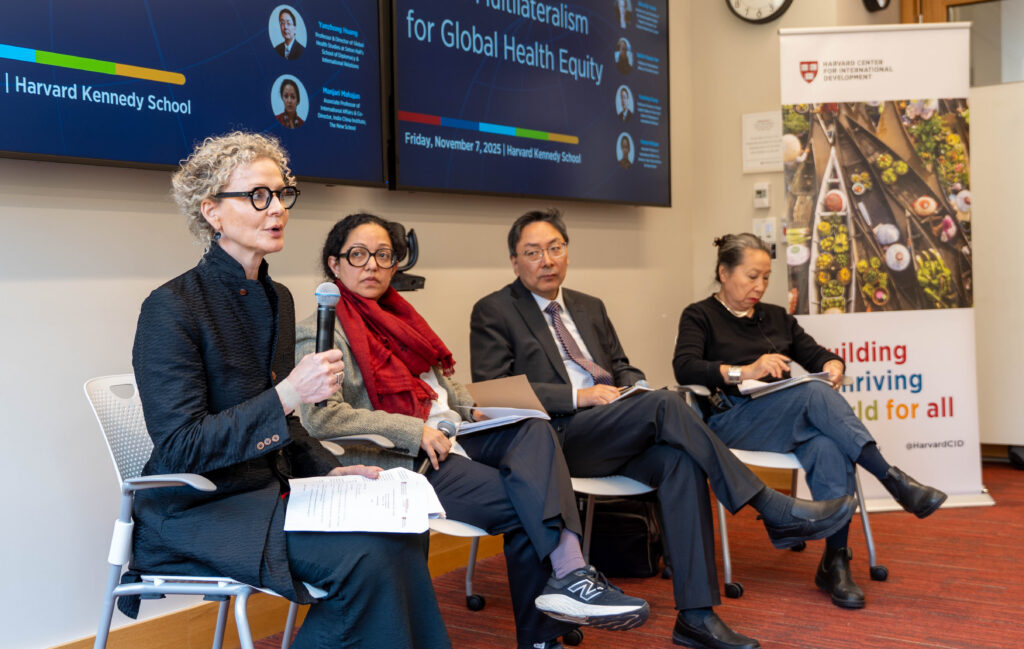
Dr. Yamin speaking at A New Multilateralism for Global Health Equity, November 7, 2025
In order to seize the opportunity to remake a system that is more democratic and meaningfully prioritizes equity, this project brings together thoughtful and engaged scholarship from multiple disciplines. We need to test and challenge orthodoxies in our different disciplines and approaches, and deliberate collectively around concrete proposals for the future of multilateralism in global health. The April 2025 meeting produced a collective document published in Global Policy (GP) Opinion, which outlined 10 principles that should be at the core of a new architecture in global health, and the likely political strategies to put the reimagined multilateral system, or systems, in place. This project develops this system in greater detail and will produce a Special Issue of Global Perspectives, as well as webinars and podcasts. It will also complement and inform work being done by Senior Fellow and GHRP director, Alicia Yamin, on the Lancet Commission on Global Governance for Health 2.0.
Scholarship
Publications
- Alicia Ely Yamin, The Paradox of Global Health Law: A Law and Political Economy Perspective, AJIL Unbound (2026).
- Alicia Ely Yamin & Camila Gianella Malca, Institutional Corruption in the Political Economy of Global Mental Health: Challenges for Transformative Human Rights Praxis, Harvard Health and Human Rights Journal (2025).
- Juan Cruz Goñi & Alicia Ely Yamin, Cartografías del abandono: El derecho a la salud frente al experimento necropolítico de La Libertad Avanza, Juan Pablo Bohoslavsky ed, Lo mío es mío y lo tuyo es mío – Neoliberalismo y derechos humanos en Argentina (2025).
- Aziza Ahmed, Alicia Ely Yamin, & Sofia Gruskin, Sexual and Reproductive Health and Rights: Advances and Setbacks, Journal of Law, Medicine & Ethics (2025).
- Alicia Ely Yamin, Constructing Maternal Mortality as A Human Rights Issue: Lessons for Using International Law to Advance Women’s Health and Rights, Jarpa Dawuni et al., eds., Oxford Handbook on Women and International Law (2025).
- Alicia Ely Yamin & Lisa Cosgrove, Extending the Concept of ‘Obstetric Violence’ to the Post-partum Period: The case of the First-ever Pill for Post-Partum Depression, Sexual and Reproductive Health Matters (2024).
- Kristine Bærøe et al., & Alicia Ely Yamin, Pandemic and Crisis Preparedness and Response: Conceptualizing Cultural, Social and Political Drivers of Trustworthiness and Collective Action, Public Health Ethics (2024).
- Alicia Ely Yamin et al., Analysing Governments’ Progress on the Right to Health, Bull World Health Organization (2024).
- Alicia Ely Yamin, Agustina Ramón Michel, et al., Usando direitos para aprofundar a democracia: entendiendo o caminho para aborto legal na Argentina, Revista do Instituto Histórico e Geográfico Brasileiro (2024).
- Meesha Vullikanti & Alicia Ely Yamin, Obstetric violence is not a misnomer, American Journal of Obstetrics and Gynecology (2024).
- Alicia Ely Yamin, Using Human Rights to Advance Global Health Justice in An Age of Inequality, PLoS Global Health (2024).
- Alicia Ely Yamin, Evolving Human Rights Struggles for Health and Social Equality, Second Edition, Stanford University Press (2023).
- Alicia Ely Yamin, Derecho a la salud y estrategias de priorización: La sentencia T 237/2023 de la Corte Constitucional colombiana, La Ley (2023).
- Alicia Ely Yamin & Agustina Ramón Michel, Using Rights to Deepen Democracy: Making Sense of the Road to Legal Abortion in Argentina, Fordham International Law Journal (2023).
- Silvina Ramos et al., & Alicia Ely Yamin, Step by Step in Argentina: Putting Abortion Rights into Practice, International Journal Women’s Health (2023).
- Alicia Ely Yamin, Five Lessons for Advancing Maternal Health Rights in an Age of Neoliberal Globalization and Conservative Backlash, Harvard Health and Human Rights Journal (2023).
- Alicia Ely Yamin, Derecho a la salud y estrategias de priorización: La sentencia T 237/2023 de la Corte Constitucional colombiana, La Ley (2023).
- Alicia Ely Yamin,T-760/08 (Constitutional Court of Colombia), in Max Planck Encyclopedia of Comparative Constitutional Law (Revised, 2023).
- Camila Gianella & Alicia Ely Yamin, Struggle and Resistance: Using International Bodies to Advance Sexual and Reproductive Rights in Peru, International Sexual and Reproductive rights Lawfare (2023).
- Alicia Ely Yamin & Tara Boghosian, The Right to Health: Reclaiming Imperatives of Democratic Justification, The Oxford Handbook of Economic and Social Rights (2023).
- Alicia Ely Yamin & Agustina Ramón Michel, Engendering Democracy, Advancing Reproductive Justice: The Legalization of Abortion in Argentina, Edward Elgar Research Handbook on International Abortion Law (2023).
- Joelle Grogan & Alicia Ely Yamin, A Functionalist Approach to Analyzing Legal Responses Across Countries: Comparative Insights from Two Global Symposia, COVID-19 and the Law: Disruption, Impact and Legacy, (2023).
- Alicia Ely Yamin, Luciano Bottini Filho & Camila Gianella Malca, Advancing the Right to Health: From Exhortation to Action, WHO Council on the Economics of Health for All Insight #5 (2023).
- Alicia Ely Yamin, Access to Medicines and the Right to Health: A Primer for Students and Advocates, Journal des Droit de la Sante et de l’ Assurance Maladie (2022).
- Alicia Ely Yamin, Stefania Negri, & Roojin Habibi, On Sea Monsters and Sandcastles: Revisiting International Legal Frameworks Regarding Public Health and Human Rights in Global Health Emergencies, Yearbook of International Disaster Law (2022).
- Alicia Ely Yamin & Alison Roberts, Medical Research and Human Rights, Edward Elgar Encyclopedia of Human Rights (2022).
- Alicia Ely Yamin, The Right to Health: Democracy and the Limits of Rights, Oxford Handbook on Latin American Constitutional Law (2022).
- Alicia Ely Yamin, Future Directions for Human Rights Praxis in Health: The Imperative of (Re)claiming the Public, La Revue des Juristes de Sciences (2021).
- Alicia Ely Yamin, Re-Imagining Possibilities of Governance for Global Health, Georgia Journal of International and Comparative Law (2021).
- Alicia Ely Yamin, Los Retos y las posibilidades para la gestión de la información en salud: Una mirada desde los derechos humanos, Revista Farm, Argentina (2021).
- Göran Tomson et al., & Alicia Ely Yamin, Solidarity and Universal Preparedness for Health Post COVID-19, British Medicine Journal (2021).
- Alicia Ely Yamin, Neil Datta, & Ximena Andion, Behind the Drama: The Roles of Transnational Actors in Legal Mobilization Over Sexual and Reproductive Rights, Georgetown Journal of Gender and the Law (2021).
- Alicia Ely Yamin, From health to political economy: How we ‘know what we know’ and why intersecting matters now, Intersecting: Sustainable Responses to the COVID-19 Pandemic (2021).
- Alicia Ely Yamin, The Alchemy of Agency: Reflections on Supported Decision-Making, Health Systems and the Right to Health, Mental Health, Legal Capacity, and Human Rights (2021).
- Alicia Ely Yamin, On Principle and Persuasion: Examining Philip Alston’s Contribution to Economic and Social Rights through the Lens of Health, The Struggle for Human Rights: Essays in honour of Philip Alston (2021).
- Roojin Habibi et al., & Alicia Ely Yamin, The Stellenbosch Consensus on Legal National Responses to Public Health Risks: Clarifying Article 43 of the International Health Regulations, International Organizations Law Review (2020).
- Margherita Ciná et al., & Alicia Ely Yamin, The Stellenbosch Consensus on Legal National Responses to Public Health Risks: Clarifying Article 44 of the International Health Regulations, International Organizations Law Review (2020).
- Alicia Ely Yamin, A Wake-Up Call in Our Upside-Down World: Three Lessons for Advancing Health Rights and Social Justice in a Post-Pandemic Future, Journal of Human Rights Practice (2020).
- Alicia Ely Yamin & Tara Boghosian, Democracy and Health: Situating Health Rights within a Republic of Reasons, Yale Journal of Health Policy, Law & Ethics (2020).
- Joy Phumaphi et al., & Alicia Ely Yamin, A crisis of accountability for women’s, children’s and adolescents’ Health, The Lancet (2020).
- Allyn L. Taylor et al., & Alicia Ely Yamin, Solidarity in the wake of COVID-19: reimagining the International Health Regulations, The Lancet (2020).
- Alicia Ely Yamin, The Right to Health, Edward Elgar Research Handbook on Economic, Social and Cultural Rights (2020).
- Elizabeth Mason, Gita Sen, & Alicia Ely Yamin, Universal Health Coverage Provisions for Women, Children, and Adolescents, Bulletin of the World Health Organization (2020).
- Nicholas Alipuhi et al., & Alicia Ely Yamin, Advancing Women’s, Children’s, and Adolescents’ Health and Equity, British Medicine Journal (2020).
- Roojin Habibi et al., & Alicia Ely Yamin, Do not violate the International Health Regulations during the COVID-19 outbreak, The Lancet (2020).
- Juan Pablo Bohoslavsky & Alicia Ely Yamin, Hay Alternativa: Agendas transformadoras [There is an Alternative: Transformative Agendas], La Pandemia de la desigualdad [The Pandemic of Inequality (2020).
- Joy Phumaphi et al., & Alicia Ely Yamin, Caught in the COVID Storm: Accountability For Women, Children’s and Adolescents’ Health, World Health Organization, UN Secretary General’s Independent Accountability Panel for Women’s, Children’s and Adolescents’ Health in the SDGs (2020).
- Alicia Ely Yamin, Struggles for Human Rights in Health in an Age of Neoliberalism: From Civil Disobedience to Epistemic Disobedience, Journal of Human Rights Practice (2019).
- Lawrence Gostin et al., & Alicia Ely Yamin, The legal determinants of health: harnessing the power of law for global health and sustainable development, The Lancet Commission on Global Health and the Law (2019).
- Alicia Ely Yamin, The Right to Health in Latin America: The Challenges of Constructing Fair Limits University of Pennsylvania Journal of International Law (2018).
Commentary
- Alicia Ely Yamin, Emma Joanna Lengle, & Gregg Gonsalves, US public health resistance must include Palestine – Author’s reply, The Lancet (2025).
- Alicia Ely Yamin, Extractivism and Colonialism in Argentina: A View from the Patagonia, ReVista: Harvard Review of Latin America (2025).
- Alicia Ely Yamin, Chasing Accountability in Global Health: Reflections from Experience on the UN Secretary-General’sIndependent Accountability Panel on Women’s, Children’s, and Adolescents’ Health, Harvard Health and Human Rights Journal (2025).
- Alicia Ely Yamin, Camila Gianella Malca, & Daniela Cepeda, Examining Institutional Corruption in Mental Health: A Key to Transformative Human Rights Approaches, Harvard Health and Human Rights Journal (2025).
- Chloe Dahleen & Alicia Ely Yamin, We Must Demand More: Health Finnacing after Financing Development Conference, Geneva Health Files (2025).
- Sakiko Fukuda-Parr, Alicia Ely Yamin, et al., New Multilateralism for Promoting Equity and Global South Agency: Principles, politics and strategies for remaking the global health architecture, Global Policy (2025).
- Alicia Ely Yamin, Emma Joanna Lengle, & Gregg Gonsalves, Building A Resistance to US Assaults on Public Health, The Lancet (2025).
- Alicia Ely Yamin & Sabrina Ochoa, A Dangerous Departure: The Inter-American Court’s Failure to Squarely Address Abortion in Beatriz v El Salvador, Verfassungsblog (2025).
- Alicia Ely Yamin, Standing our Ground: Holding onto Powerful Counter-Narratives in Global Health, The Collective Blog (2025).
- Thalia Viveros Uehara & Alicia Ely Yamin, COP29 and the UNFCCC’s Health Turn: Progress or Peril? Bill of Health (2024).
- Alicia Ely Yamin & Thalia Viveros Uehara, Climate Change and Health: Mobilizing Public International Law into Action: Introduction, Bill of Health (2024).
- Joel Curtain & Alicia Ely Yamin, UN Tax Convention: A Structural Transformation for Financing Health, Geneva Health Files (2024).
- David McCoy, Anu Joshi, Rajat Khosla, Marta Schaaf, & Alicia Ely Yamin, Global health governance and the challenge of holding power to account: UNU-IIGH working paper, United Nations University International Institute for Global Health (2024).
- Alicia Ely Yamin, Atacar la educación pública es un ataque a la democracia, Clarín (2024).
- Timothy Fish Hodgson, Roojin Habibi, & Alicia Ely Yamin, Conclusion to the Symposium: From Principles to Practice: Human Rights in Public Health Emergencies, Bill of Health (2024).
- Luciano Bottini Filho, Camila Gianella, & Alicia Ely Yamin, Can Rights Make any Difference for Access to Health?: Insights from a Scoping Review on Constitutional Rights for the WHO Council on Economics of Health for All, Bill of Health (2023).
- Roojin Habibi, Tim Fish Hodgeson, & Alicia Ely Yamin, Introduction to the Symposium: From Principles to Practice, Bill of Health (2023).
- Alicia Ely Yamin & Selene Manga, Struggles and Resistance in Peru: Dispatches from Cusco, ReVista (2023).
- Alicia Ely Yamin, Priority-Setting and the Right to Health: Important Advances and Missed Opportunities from the Colombian Constitutional Court, I•CONnect Blog (2023).
- Alicia Ely Yamin, Reframing Freedom from Violence to Advance Health Rights in an Era of Neoliberal Globalization, The Collective Blog (2023).
- Jashodhara Dasgupta, Sakiko Fukuda-Parr, Anand Grover, & Alicia Ely Yamin, Decolonizing Global Health: Human Rights, The Collective Blog (2023).
- Alicia Ely Yamin & Sabrina Ochoa, What’s at Stake in the Abortion Case before the Inter-American Court of Human Rights? EJIL:Talk! (2023).
- Alicia Ely Yamin, Decriminalizing Abortion in Argentina: 8 Takeaways from the Inflection Point of Legalization, Bill of Health (2023).
- Alicia Ely Yamin & Joel Curtain, Lessons from the pandemic: Building a movement for global public investment, Open Global Rights (2022).
- Alicia Ely Yamin & Natalia Echegoyemberry, Searching for Environmental Justice in Argentina: Revisiting the Reality of the Matanza-Riachuelo River Basin Case after Fifteen Years, Bill of Health (2022).
- Alicia Ely Yamin, Reproductive Governance in a Post-Roe US: The Weaponization of Health Systems, Bill of Health (2022).
- Alicia Ely Yamin, The Legacy of Dr. Paul Farmer: A Clarion Call for Transformative Human Rights Praxis in Global Health, Open Global Rights (2022).
- Alicia Ely Yamin, Editorial: Can a Pandemic Law-Making Exercise Promote Global Health Justice? Verfassungsblog (2022).
- Alicia Ely Yamin, The Stakes of the Pending Colombian Constitutional Court Abortion Decision, Bill of Health (2022).
- Sakiko Fukuda-Parr, Paulo Buss, & Alicia Ely Yamin, Pandemic treaty needs to start with rethinking the paradigm of global health security, BMJ Global Health (2021).
- Alicia Ely Yamin, Critical Approaches to Teaching Health and Human Rights in a Pandemic, Stanford University Press Blog (2020).
- Alicia Ely Yamin & Tara Boghosian, Democratizing Health Systems and Health Justice, Journal of Law and Political Economy Blog (2021).
- Alicia Ely Yamin, Regional Insights for Constitutionalizing the Right to Health in Chile, Bill of Health (2020).
- Alicia Ely Yamin, Human Rights Parables for a Post-Pandemic Future, The Lancet, Foundations of Global health and Human Rights (2020).
- Joy Phumaphi, Elizabeth Mason, & Alicia Ely Yamin, Opinion: Why the SDGs’ defining decade must focus on accountability for those left behind, Devex (2020).
- Alicia Ely Yamin, Post-pandemic collective action for health rights and social justice is essential, Open Global Rights (2020).
- Alicia Ely Yamin & Ole F. Norheim, 3 Human Rights Imperatives for Rationing Care in the Time of Coronavirus, Bill of Health (2020).
- Alicia Ely Yamin, Truths and Lies about this Pandemic: What are the lessons for health rights and social justice? GI-ESCR Blog (2020).
- Alicia Ely Yamin & Roojin Habibi, Human Rights and Coronavirus: What’s at Stake for Truth, Trust, and Democracy, Health and Human Rights (2020).
- Alicia Ely Yamin, What Role for Human Rights in Global Health? International Health Policies (2020).
- Alicia Ely Yamin, Putting Human Rights at the Centre of Struggles for Health and Social Equity, Open Global Rights (2020).
- Alicia Ely Yamin, A Letter to Young and Future Leaders of Struggles for Health Rights and Social Justice, Health and Human Rights (2019).
- Alicia Ely Yamin, Silencing the Drama: Do the SDGs Expose the Limitations on Women’s Sexual and Reproductive Rights? Open Global Rights (2019).
- Roberto Andorno & Alicia Ely Yamin, The Right to Design Babies? Human Rights and Bioethics Open Global Rights (2019).
Digital Symposia
- Alicia Ely Yamin & Thalia Viveros Uehara, Climate Change and Health: Mobilizing Public International Law into Action, Bill of Health (2024).
- Beyond Siracusa: Human Rights in Times of Public Health Emergencies, International Commission of Jurists (2024).
- Timothy Fish Hodgeson, Roojin Habibi, Alicia Ely Yamin, Principles and Guidelines on Human Rights and Public Health Emergencies, International Commission of Jurists (2023).
- Alicia Ely Yamin, Joelle Grogan and Pedro Villareal, International Pandemic Lawmaking: Conceptual and Practical Issues, Bill of Health (2021) .
- Alicia Ely Yamin, Global responses to COVID-19: Democracy, Rights and Law, Bill of Health (2020).
Multimedia Materials
- Alicia Ely Yamin, The Female Empowerment Podcast, “When Health Becomes A Right,” (2025).
- Alicia Ely Yamin, Harvard Faculty Voices Podcast, “Mexico’s Judicial Reform Plan,” (2024).
- Alicia Ely Yamin, Abortion Rights in the US, Global Health Education and learning Incubator, Harvard University (2022).
- Alicia Ely Yamin, Accountability in Global Health and the Sustainable Development Goals (SDGs), Global Health Education and learning Incubator, Harvard University in partnership with Independent Accountability Panel (2019).
- Alicia Ely Yamin, Part I: Understanding Gender, Overcoming Stereotypes, Global Health Education and learning Incubator, Harvard University (2019). Spanish Translation
- Alicia Ely Yamin, Part II: Health Systems with a Focus on Adolescents, Global Health Education and learning Incubator, Harvard University (2019). Spanish Translation
Events
- The Inter-American Court of Human Rights’ “Right to Care” February 10, 2026
- A New Multilateralism for Global Health Equity November 7, 2025
- When Youth Sue to Protect the Planet and their Health: Inside a Bold Legal Strategy to Fight Climate Change April 1, 2024
- The Role of Courts in Advancing the Right to a Healthy Environment: Lessons from Latin America March 29, 2024
- Power and Money in Global Health: A conversation with Tim Schwab about “The Bill Gates Problem: Reckoning with the Myth of the Good Billionaire” February 22, 2024
- From Principles to Practice: Critical Reflections on Human Rights Advocacy in Public Health Emergency Prevention, Preparedness and Response January 18, 2024
- Toward a More Effective, Equitable Pandemic Response October 16, 2023
- Abortion Rights & Reproductive Justice in Latin America October 21, 2022
- Health Justice in the Americas: The Role of the Inter-American Court of Human Rights April 05, 2022
- Exporting Mayhem: Suing Gun Manufacturers in the US to Stop Violence in Mexico February 17, 2022
- Disruptions of Dignity: COVID-19 and the Rights of Persons with Disabilities in Latin America October 8, 2021
- Engendering Democracy: The Significance of Abortion Legalization in Argentina September 14, 2021
- COVID-19 & Disability: A Holistic Examination of Pandemic Impact March 09, 2021
- Enforcing Constitutional Commitments to Health and Social Equality in Kenya: A Conversation with Justice Mumbi Ngugi November 19, 2020
- Constitutional Democracy and the Role of High Courts in Times of Crisis: The Case of Mexico October 23, 2020
- COVID-19 and the Stakes for Democracy in South America September 17, 2020