Poisoned Wells: Iowa’s Fertilizer Crisis
Iowa is the only state bounded on either side by major rivers, fitting borders for a state whose prosperity is defined by water. The state has long been one of the nation’s most agriculturally productive.

Published
Author
Share
Iowa is the only state bounded on either side by major rivers, fitting borders for a state whose prosperity is defined by water. The state has long been one of the nation’s most agriculturally productive. That success owes much to its ability to manage water; irrigation to bring water onto farmland, and embedded drainage tiles to direct excess water off it. To this day, Iowa’s rivers and streams remain its “lifeblood,” enabling its agricultural identity. It is ironic, then, that Iowans are now being poisoned by their own water.
A Health Catastrophe
Drainage made Iowa’s land arable, but fertilizer made its bountiful harvests possible. Nitrogen use in the corn belt “exploded” after the Second World War, and Iowa regularly purchases more fertilizer than any other state, helping to cement its agricultural success. But nitrates are highly water soluble, making agricultural runoff inevitable. Since the late 1980s, Iowa’s rivers and groundwater have contained nitrates at levels high enough to cause immediate health problems.
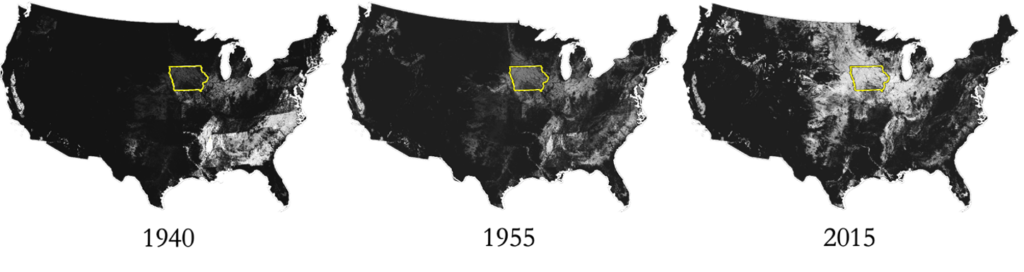
It is therefore not surprising that Iowa has the second-highest age-adjusted rate of cancer diagnoses and is one of only two states where that rate is still increasing.
Despite this dubious distinction, the state’s response has been timid. A 2025 report concluded that 80 percent of nitrate in Des Moines’s waterways comes from agriculture. But after the report squarely placed responsibility on agriculture, the “big ag” lobby successfully pressured the county to “zero[] out” the researchers’ budget. Despite 72 percent of Iowans viewing water pollution as a “very serious concern,” legislators have continued to pass “numerous pro-polluter bills” since 2020, including legislation defunding the state’s river-monitoring network.
Clean Water Act Falls Short
Fertilizer runoff is diffuse, making it difficult to regulate. The Clean Water Act (“the Act”) forbids discharging pollutants into “navigable waters” without a permit, but has proven a poor tool for combating contamination of Iowa’s drinking water.
First, the Act primarily regulates “point source” pollution from “discernible, confined and discrete” sources such as pipes and man-made ditches. Agricultural runoff, however, percolates through soil, streams, and groundwater. Despite accounting for 92 percent of the total nitrate entering Iowa’s streams, such “nonpoint sources” remain subject only to voluntary state and federal programs.
Second, agriculture receives preferential treatment even where the Act might otherwise apply. The Act excludes “agricultural storm water discharges … from irrigated agriculture” and “normal farming” activities. In sum, the general framework of the Act contains an agriculture exemption.
Lastly, the Supreme Court narrowed the Act’s reach in 2023, holding that it covers only bodies of water “described in ordinary parlance as ‘streams, oceans, rivers, and lakes.’” That ruling excluded many stationary pollutant destinations, including groundwater reservoirs, which supply drinking water to more than 75 percent of Iowans. The Clean Water Act therefore has done little to address nutrient contamination of drinking water.
At the Well
Some states have filled the regulatory gap and closely scrutinize agricultural runoff. Iowa has chosen a laissez-faire path that is woefully inadequate. Runoff harms distant communities and many of nitrate’s most serious health effects — cancers, infertility, thyroid diseases — can take decades to manifest. Moreover, because nitrate is cheap, farmers face little incentive to limit excessive use.
In a state unwilling to address the issue at its source, the only alternative is protection at the point of consumption. Water treatment technologies are improving quickly, but remain expensive and “beyond the financial and technical capabilities of the many small towns in Iowa.” Moreover, roughly 10 percent of Iowa households rely on private wells. In 2017, 12 percent of such wells tested above the nitrate concentration associated with immediate health problems, and 22 percent above levels associated with increased cancer risk. Iowa offers free well testing, but more than 70 percent of households do not test annually, and most lack nitrogen-removing filters. That means that roughly 76,000 Iowans do not know whether the water they are drinking is safe.
This burden falls disproportionately on rural communities, which are more likely to sit near runoff and rely on untreated private wells. Even when testing is free, “people … simply don’t want to test their well water because they can’t afford to do much about it if they find out that their nitrate levels are unsafe.” When water treatment is prohibitively expensive, there is no substitute for state regulation.
Other States
Iowa’s private-well problem is not unique. In fact, about 15 percent of Americans rely on private wells for drinking water. But the federal laws that do exist cover only public water systems. A minority of states require testing before first use, sale, or rental. Others impose equitable obligations on polluters once contamination is found, such as providing potable water and long-term well treatment for the households they’ve contaminated.
Most states, however, leave testing to homeowners. That approach is dangerous for nitrate, which is “colorless, odorless, and tasteless.” And polluters can affect ecosystems a hundred miles away. At such distances, it is unreasonable to expect homeowners to detect the problem on their own and respond appropriately.
Iowa should therefore require annual testing of private wells, using the testing strips the state already provides for free. Mandatory testing would not stop fertilizer runoff at its source, but it would help Iowans detect contamination before they drink unsafe water.
A New Threat
Many states have recently expressed a renewed interest in private-well regulation. Their anxieties, however, are not nitrates but PFAS, the widely used family of “forever chemicals.” Wisconsin, for example, budgeted $133 million in March to address PFAS contamination. Echoing Iowa’s experience, state officials explain that “[o]ne of the biggest challenges is helping well owners understand why they should take the threat seriously.”
Iowa has spent decades minimizing the threat posed by fertilizer runoff. But its residents realize that the pollution of their drinking water is a “very serious issue.” PFAS will only intensify those concerns. It is time for Iowa’s politicians to stop pretending they can ignore the problem. If a new wave of private-well reform is coming, Iowans cannot afford to miss it.