Behavioral Health

  • Read more: Are we speaking the same language? An alphabet soup of acronyms in the opioid epidemic

    Are we speaking the same language? An alphabet soup of acronyms in the opioid epidemic

    By Stephen Wood Medication Replacement Therapy (MRT), Medication Assisted Therapy (MAT). Opioid Substitution Treatment (OST). Opioid Replacement Therapy (ORT). Opioid Agonist Therapy (OAT). This confusing array of acronyms are all terms that have made their way into the dictum of patients, healthcare providers, policy leaders, politicians and journalists —and new ones pop up every day. Buprenorphine…

  • Read more: After Julie Eldred, Considering Addiction as Disease or Choice

    After Julie Eldred, Considering Addiction as Disease or Choice

    By Chris Hutchison-Jones Is substance addiction a choice or a disease? In the recent ruling by the Massachusetts Supreme Court in the case of the Commonwealth vs. Julie A Eldred judges had to consider this question. But they came to the wrong conclusion.

    greyscale handcuffs, pills and gavel
  • Read more: Introduction to “Diseases of Despair: The Role of Policy and Law”

    Introduction to “Diseases of Despair: The Role of Policy and Law”

    By Wendy E. Parmet and Jennifer Lea Huer We are pleased to host this symposium featuring commentary from speakers and participants of Northeastern University School of Law’s annual health law conference, Diseases of Despair: The Role of Policy and Law, organized by the Center for Health Policy and Law. All the posts in the series…

    "Diseases of Despair: The Role of Policy and Law" conference banner
  • Read more: The Healing Potential of Medical-Legal Partnerships

    The Healing Potential of Medical-Legal Partnerships

    This post is part of a symposium from speakers and participants of Northeastern University School of Law’s annual health law conference, Diseases of Despair: The Role of Policy and Law, organized by the Center for Health Policy and Law. All the posts in the series are available here. By Tamar Ezer As we grapple with today’s social ills…

    two hands connecting white puzzle pieces together
  • Read more: Many State Laws Undermine Harm Reduction Strategies in the Opioid Crisis

    Many State Laws Undermine Harm Reduction Strategies in the Opioid Crisis

    This post is part of a symposium from speakers and participants of Northeastern University School of Law’s annual health law conference, Diseases of Despair: The Role of Policy and Law, organized by the Center for Health Policy and Law. All the posts in the series are available here. By Aila Hoss Despite the increase in rates of opioid…

    protestor holding a sign "Needle Exchange Saves Lives"
  • Read more: Reports on the Opioid Crisis are Full of Misidentified Problems and Poorly Calibrated Solutions

    Reports on the Opioid Crisis are Full of Misidentified Problems and Poorly Calibrated Solutions

    This post is part of a symposium from speakers and participants of Northeastern University School of Law’s annual health law conference, Diseases of Despair: The Role of Policy and Law, organized by the Center for Health Policy and Law. All the posts in the series are available here. By Nicolas Terry The epidemic associated with Opioid Use Disorder (OUD)…

    stack of files
  • Read more: Buprenorphine and Naloxone Legislative Restrictions: A Compromise Towards Harm Reduction

    Buprenorphine and Naloxone Legislative Restrictions: A Compromise Towards Harm Reduction

    By Stephen Wood There were approximately 64,000 deaths from opioid overdose in 2016, including deaths from both prescription and illicit drugs. The incidence of opioid overdose has continued to escalate despite a number of efforts. Increasing treatment beds, limiting opioid prescriptions, distribution of naloxone and other efforts have not demonstrated a significant impact on non-medical…

  • Read more: The Need for Institutional, Individual and Community Based Responses to the Opioid Crisis

    The Need for Institutional, Individual and Community Based Responses to the Opioid Crisis

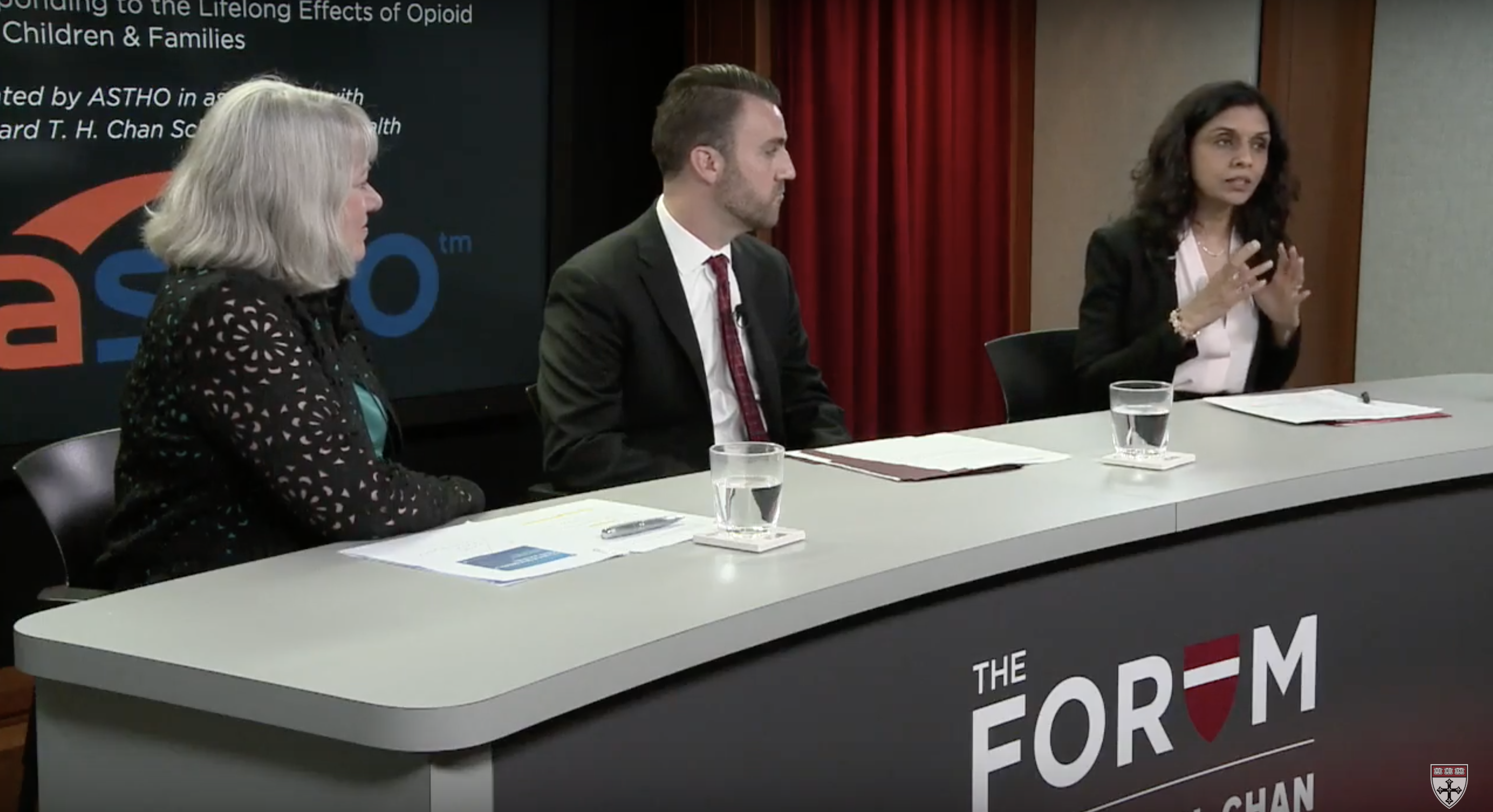
    By John Alexander Short Dr. Monica Bharel, the Commissioner of the Massachusetts Department of Health, recently hosted a webinar panel to discuss the many consequences of the modern opioid epidemic on families. Hosted jointly by the Association of State and Territorial Health Officials (ASTHO) and The Forum at the Harvard T.H. Chan School of Public…

    Panelists discussed responses to the opioid crisis in a webinar
  • Read more: What is in America’s Medicine Cabinet? Everything.

    What is in America’s Medicine Cabinet? Everything.

    By Stephen Wood There were 240 million opioid prescriptions in the U.S. in 2016, a number that accounts for about 30 percent of the world’s opioid prescriptions, and is enough for one opioid prescription for every adult American. Experts believe the overprescribing of opioids is at least somewhat responsible for the current opioid crisis. This…

    pills
  • Read more: NIMBYism continues to factor into supervised injection site policies

    NIMBYism continues to factor into supervised injection site policies

    By Daniel Goldberg As a major tool in harm reduction policy connected to opioid and substance misuse, more than 30 states have implemented syringe exchange programs, or SEPs. Surmounting or, in many cases, bypassing the considerable legal and political obstacles has proved a challenge for states, whether they succeeded in enacting SEPs or not. While,…

    supervised injection site