Law & Neuroscience

  • Read more: Neuroscience Insights to Navigate Stress and Trauma

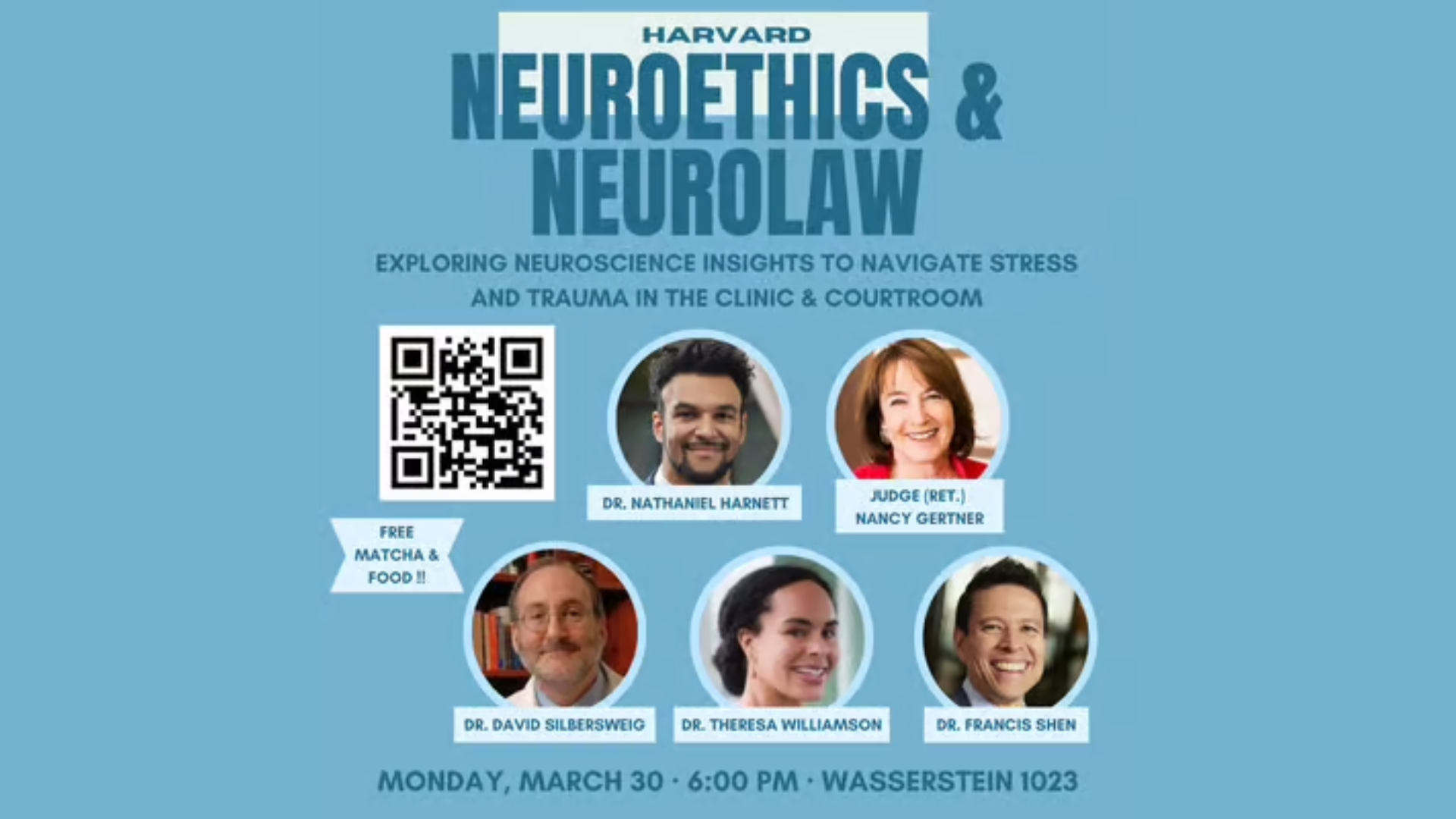
    Neuroscience Insights to Navigate Stress and Trauma

    A Harvard Neuroscience & Society Conversation with Leading Experts Trauma and stress shape our brains, but they also shape our systems. From clinics to courtrooms, the science of stress is transforming how we understand vulnerability, recovery, responsibility, and justice. ​Join us at Harvard Law School for a cross-campus, interdisciplinary conversation bringing together leaders in neurobiology, psychiatry, neurosurgery,…

  • Read more: Older Persons’ Human Rights

    Older Persons’ Human Rights

    Recording

    This virtual event will discuss a forthcoming international treaty on the rights of older persons and how it could build on lessons from the Convention on the Rights of Persons with Disabilities. On April 3, 2025, the United Nations (UN) Human Rights Council adopted a resolution jumpstarting the multilateral process for negotiating a new international treaty on the rights…

  • Read more: Courts and the Young Adult Brain

    Courts and the Young Adult Brain

    Recording

    Criminal Resentencing Post-Monschke, Mattis, and Other State Case Law  In Roper v. Simmons (2005), the U.S. Supreme Court barred the death penalty for crimes committed under 18, grounding its reasoning in developmental science. Yet Jones v. Mississippi (2021) upheld discretionary life without parole, leaving states to decide how science should inform sentencing. In the wake of Jones, courts across the…

  • Read more: How Old is Too Old to Govern?

    How Old is Too Old to Govern?

    Recording

    Join the Petrie-Flom Center and a panel of experts for an in-person lunchtime discussion of the legal, scientific, medical, and ethical issues related to aging political and judicial leaders. Is the advanced age of many leaders cause for concern? Should we have maximum age limits for lawmakers and judges? What can neuroscience research tell us about…

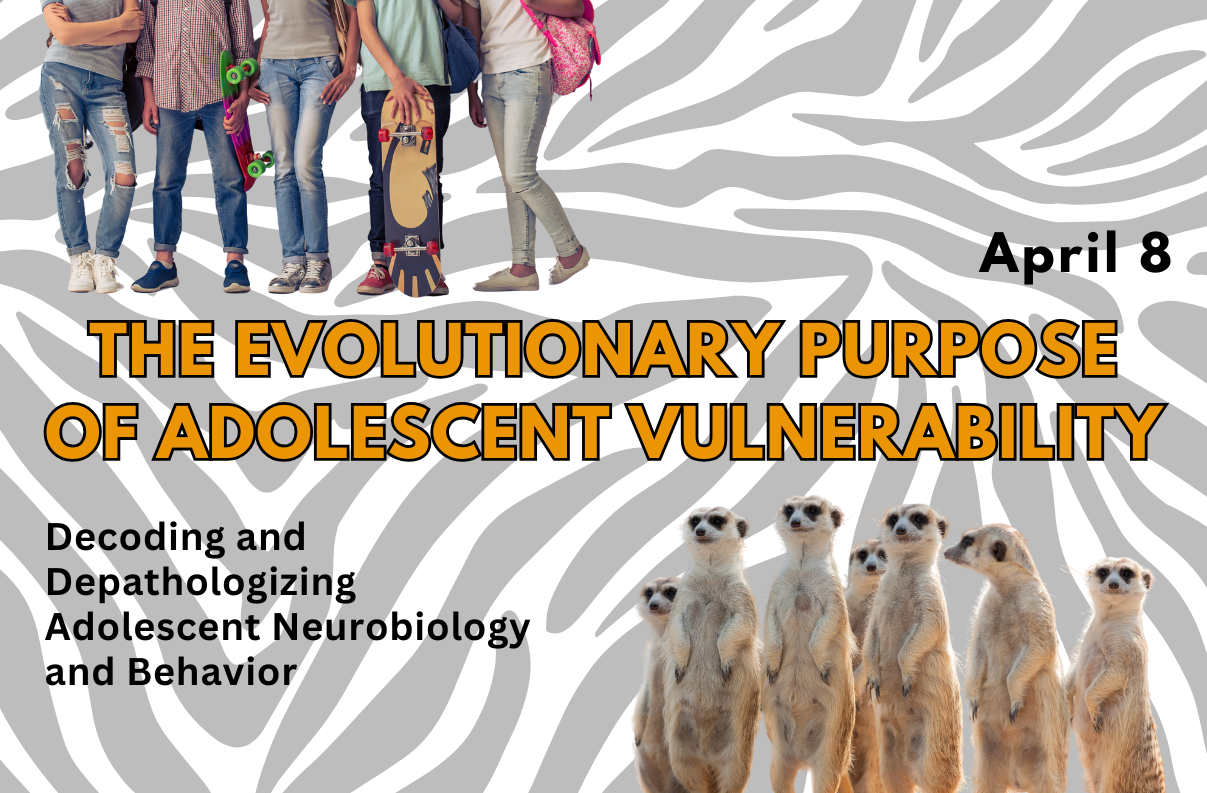
  • Read more: The Evolutionary Purpose of Adolescent Vulnerability: Decoding and Depathologizing Adolescent Neurobiology and Behavior

    The Evolutionary Purpose of Adolescent Vulnerability: Decoding and Depathologizing Adolescent Neurobiology and Behavior

    Recording

    Adolescents—human and animal alike—take risks, challenge authority, and navigate social hierarchies as part of their development. In Wildhood, Dr. Barbara Natterson-Horowitz explores how these behaviors are biologically ingrained and essential for survival. This event will examine how evolutionary biology supports the Supreme Court’s “Children Are Different” jurisprudence, reinforcing why adolescent decision-making should be understood through science rather than…

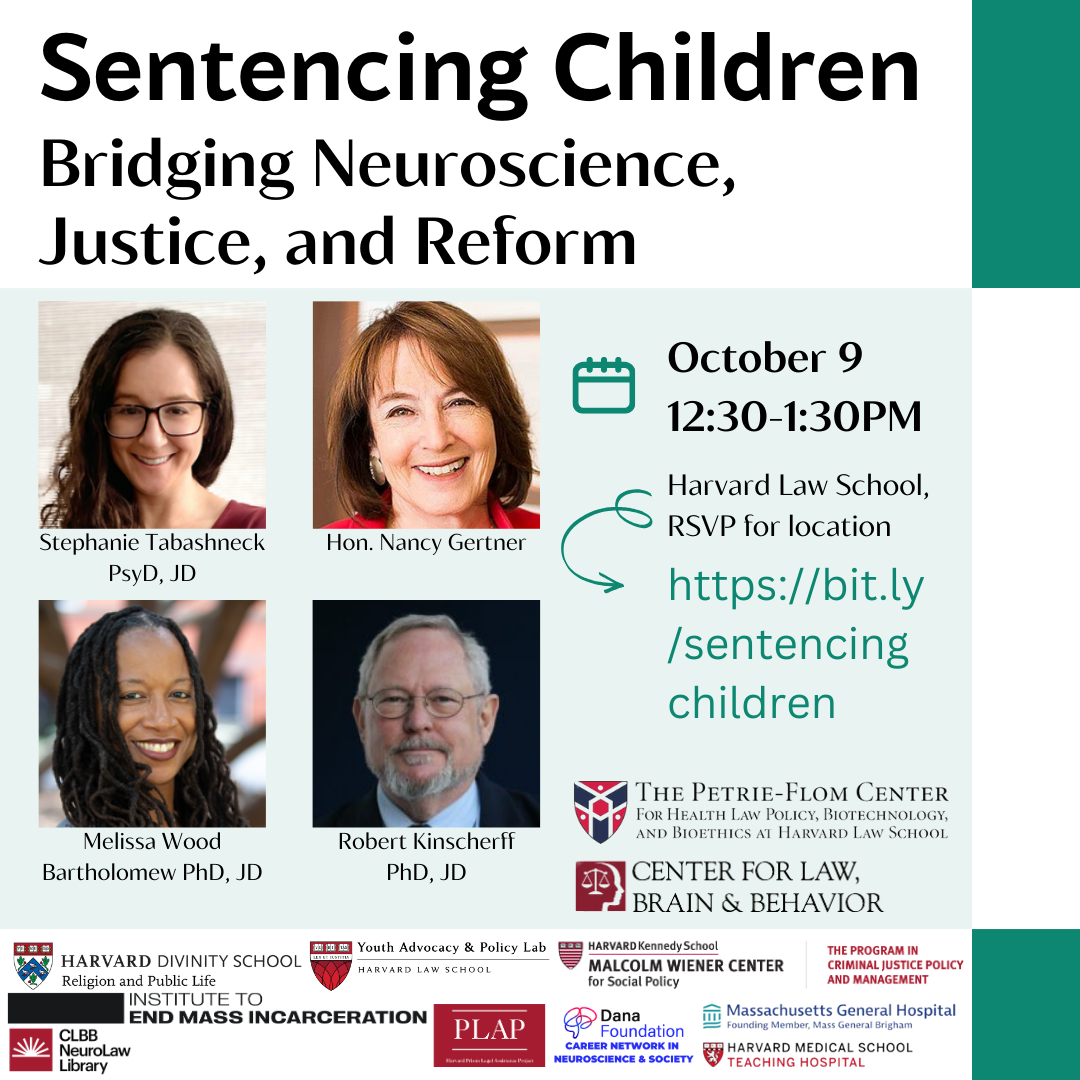
  • Read more: Sentencing Children: Bridging Neuroscience, Justice, and Reform

    Sentencing Children: Bridging Neuroscience, Justice, and Reform

    Recording

    Join us for a thought-provoking discussion on the mass incarceration of children, adolescent neuroscience, and restorative justice. Our distinguished panelists—a judge, a psychologist, and a lawyer rooted in restorative justice —will share their expertise on how we can align justice systems with science and pave the way for more humane and effective pathways forward. Recording…

  • Read more: Love and Liberalism in Surrogate Decision-Making

    Love and Liberalism in Surrogate Decision-Making

    By James Toomey If you are supposed to make a legally binding decision on behalf of someone incapacitated by dementia, chances are the law will tell you to apply the “substituted judgment” standard—you will be asked to make the decision the person for whom you are deciding would have made, if they had capacity. But…

  • Read more: Capacity and Medical Decision-Making in First- and Third-Person Perspectives

    Capacity and Medical Decision-Making in First- and Third-Person Perspectives

    By James Toomey Imagine that you were to develop dementia and someone else had to make medical decisions on your behalf. How would you want them to decide? Then suppose that you had to make medical decisions on behalf of another person with dementia. Would you think about decision-making in the same way? A new…

  • Read more: New Portable MRI Revolutionizing Brain Research Demands Ethical and Legal Innovation

    New Portable MRI Revolutionizing Brain Research Demands Ethical and Legal Innovation

    by Francis X. Shen, Susan M. Wolf, and Frances Lawrenz The advent of highly portable MRI will transform brain research, but urgently requires ethical and legal guidance. Rather than participants traveling to the MRI scanner, now the scanner can travel to them. This advance could enable research with remote and marginalized communities that have not…