Law & Neuroscience

  • Read more: New Portable MRI Revolutionizing Brain Research Demands Ethical and Legal Innovation

    New Portable MRI Revolutionizing Brain Research Demands Ethical and Legal Innovation

    by Francis X. Shen, Susan M. Wolf, and Frances Lawrenz The advent of highly portable MRI will transform brain research, but urgently requires ethical and legal guidance. Rather than participants traveling to the MRI scanner, now the scanner can travel to them. This advance could enable research with remote and marginalized communities that have not…

  • Read more: Stephanie Tabashneck: An “Interpreter” Between Two Fields

    Stephanie Tabashneck: An “Interpreter” Between Two Fields

    Stephanie Tabashneck, PsyD, JD, is a Senior Fellow in Law and Applied Neuroscience at the Petrie-Flom Center and Center for Law, Brain and Behavior (CLBB) at Massachusetts General Hospital/Harvard Medical School. A forensic psychologist and an attorney, she focuses her research, practice, and teaching on neural development in children and adolescents, substance use issues, and…

  • Read more: Neuroscience and Cannabis: Implications for Law and Policy

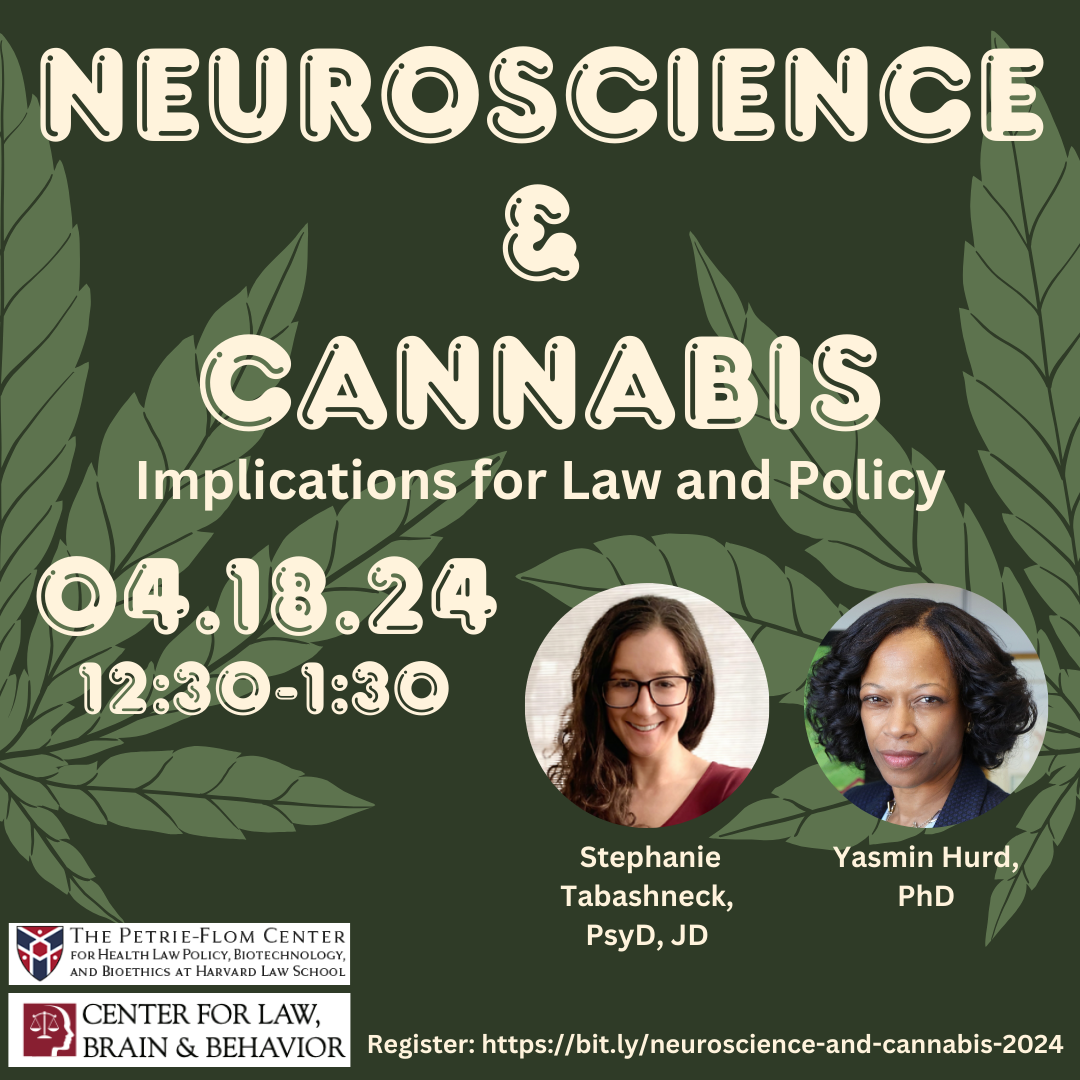
    Neuroscience and Cannabis: Implications for Law and Policy

    Recording

    The legalization of cannabis has raised significant questions for law and public policy. In her annual lecture, neuroscientist Dr. Yasmin Hurd explored the science of cannabis, CBD, and the future of substance use disorder treatment. Dr. Stephanie Tabashneck moderated a discussion and audience Q&A about the implications for law and policy.  Recording Panelists This event is part of the Project…

  • Read more: Aligning Criminal Practice with Addiction Science

    Aligning Criminal Practice with Addiction Science

    Recording

    Event Description Drawing on the science of substance use disorders (SUD), this presentation focusws on legal responses to SUD that contradict neuroscience and behavioral research, such as incarcerating individuals on probation following a relapse. Implications for bail, sentencing, probation, and parole were discussed as well as client-centered considerations. The presentation also included science-informed criminal justice…

  • Read more: Young, Vulnerable, and Betrayed: What can be done to help America’s most vulnerable children?

    Young, Vulnerable, and Betrayed: What can be done to help America’s most vulnerable children?

    Event Description A child born in America today has a 37% chance of having their welfare investigated by the state by the time they turn 18. For black children, the probability rises to 53%. Over next 18 years, 145 million American children will be referred to child protective services. What does this mean? And what…

  • Read more: Neuroscience & Society Virtual Career Fair

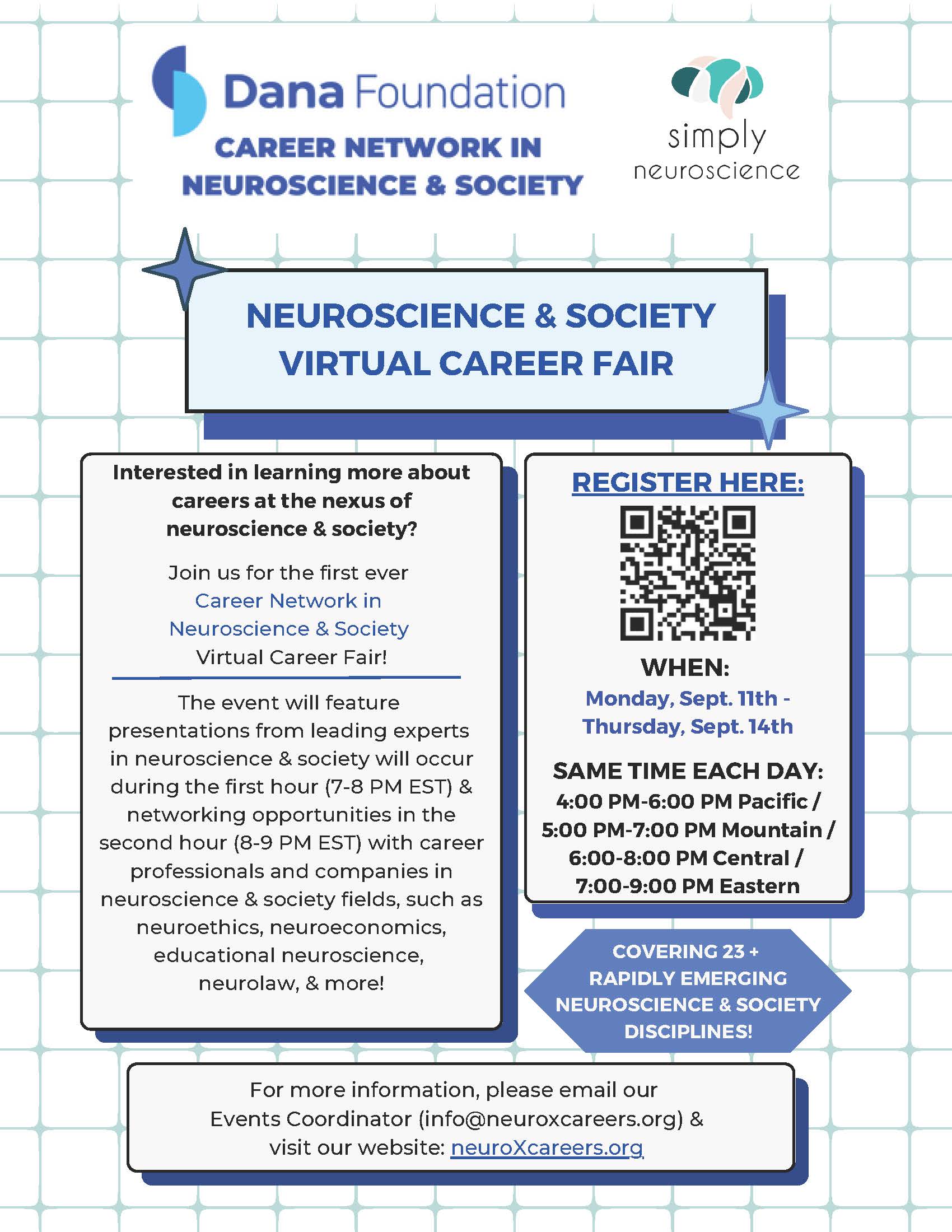
    Neuroscience & Society Virtual Career Fair

    Event Description The event will feature presentations from leading experts in neuroscience & society will occur during the first hour (7-8 PM EST) & networking opportunities in the second hour (8-9 PM EST) with career professionals and companies in neuroscience & society fields, such as neuroethics, neuroeconomics, educational neuroscience, neurolaw, & more! This event is…

  • Read more: The Battle for Your Brain

    The Battle for Your Brain

    Recording

    A conversation with Professor Nita Farahany about her new book and defending the right to think freely in the age of neurotechnology. Event Description A new dawn of brain tracking and hacking is coming. Will you be prepared for what comes next? Imagine a world where your brain can be interrogated to learn your political…